
I can still taste my first morning in Jordan. Jet-lagged and half-awake, I was standing on a hotel balcony in Amman with a cup of bitter coffee as the ritual call to prayer reverberated off sun-bleached buildings. I’d come expecting history and deserts, but what I hadn’t anticipated was the intimacy of Jordan. This is a place that does not just set its wonders before you. It makes the viewer pull closely, deeply and on occasions in ways that are quietly disturbing.
If you’re searching for things to see in Jordan, skip the glossy “Top 10” lists for a moment. Jordan is not a checklist destination. It’s a place where scale messes with your sense of time, silence becomes a character and ancient stones somehow feel emotionally heavy.
Even basic route planning became easier once I checked insights from the official Jordan tourism site, especially for travel distances and permits.
Below are the places that didn’t just impress me — they changed how I see travel.
Petra Isn’t One Place — It’s a Slow Reveal
Everyone knows Petra. Fewer people understand it.
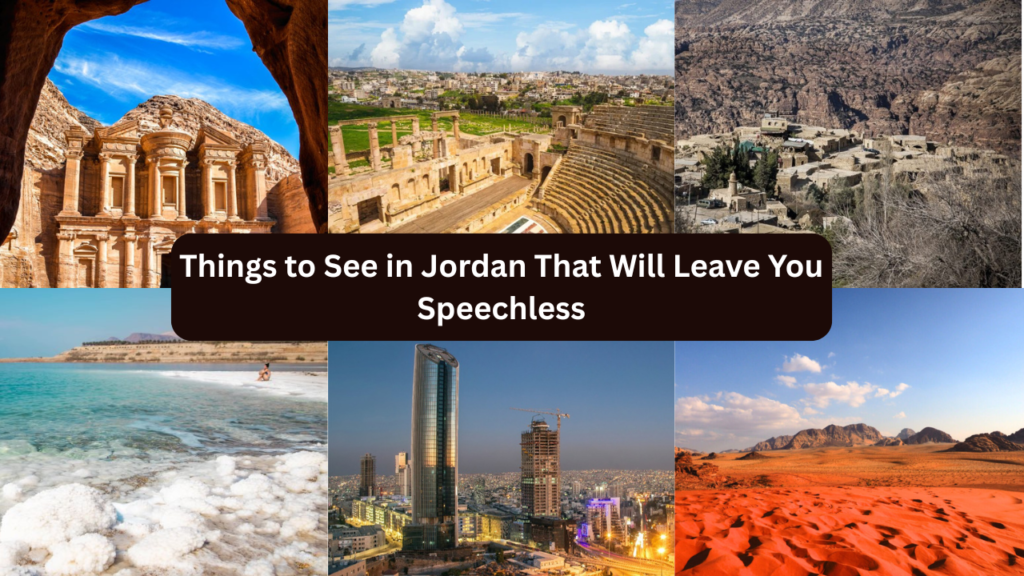
Walking through the Siq at 7 a.m., I expected the famous Treasury moment to feel… touristy. Instead, it felt theatrical in the best way. The canyon walls narrow so much that sound disappears. Then, suddenly, color. Rose-gold stone catching morning light like it’s alive.
But here’s the part most blogs skip: the Treasury is only the beginning.
I spent nearly eight hours inside Petra and the places that stayed with me weren’t the postcard shots.
- The silence near the Royal Tombs when tour groups leave
- The exhaustion climbing to the Monastery — and the unexpected tea invitation at the top
- The realization that Nabataean water systems still outperform some modern cities
Petra reminded me why I travel in the first place — those rare moments when adventure meets the soul and effort turns into meaning.
Unexpected insight: Petra rewards slowness. Rushing through it feels like skimming a novel’s first chapter and calling it finished.
📌 Practical note: Wear trail shoes, not sneakers. The steps are uneven, dusty and punishing by midday.
Wadi Rum: When Silence Becomes Loud
Wadi Rum is often described as “Mars on Earth.” Accurate — but incomplete.
What struck me wasn’t the red sand or towering rock formations. It was how quiet everything became after sunset. No engines. No cities. Just wind brushing over dunes.
Wadi Rum has the same emotional pull I felt while exploring other raw landscapes, where nature feels vast enough to reset your thinking.
I stayed in a Bedouin camp that promised “authentic experience.” I rolled my eyes — until dinner.
We ate mansaf under the stars, sitting cross-legged, passing plates by hand. No phones. No rush. The guide pointed to the Milky Way and casually said, “That’s our roof.”
What worked:
- Sunrise camel ride — surreal, not gimmicky
- Bedouin stories told without translation apps
What didn’t:
- Jeep tours at midday — harsh light kills the magic
Wadi Rum isn’t about doing more. It’s about undoing noise.
The Dead Sea: Floating, Failing, Laughing
Floating in the Dead Sea sounds glamorous.
Reality? It’s weird. And hilarious.
I slid in confidently, leaned back and immediately rotated like a capsized turtle. Salt stings every cut you didn’t know you had. You will laugh at yourself.
But here’s what surprised me: the emotional weight of the place.
Standing at the lowest point on Earth, staring as the shoreline gets farther away year after year, you feel the vulnerability of natural treasures. The locals are speaking not as activists but as witnesses, in an open conversation about water diversion, climate change and loss.
Mini comparison:
Dead Sea vs. spa resorts
- Spa: curated relaxation
- Dead Sea: raw, humbling, imperfect
📌 Tip: Don’t shave beforehand. Trust me.
Jerash: Rome Without the Crowds
I’ve seen Roman ruins in Italy, Turkey, even Tunisia. Jerash hit differently.
Maybe because I could walk freely through Hadrian’s Arch without fighting selfie sticks. Maybe because the acoustics in the amphitheater still work — I tested them, whispering from the stage.
Jerash feels untouched, not staged.
Unexpected detail: The city layout makes modern urban planners look lazy. Drainage, road hierarchy, public spaces — all intentional.
This is one of the things to see in Jordan that quietly over-delivers.
Amman: A City That Doesn’t Perform for You
Amman doesn’t try to impress — and that’s exactly why it works.
It’s chaotic, layered, sometimes confusing. Roman ruins sit next to brutalist buildings. Falafel shops outshine fine dining.
One night, a local friend took me to a tiny kunafa spot. No English menu. No Instagram sign. Just sugar, cheese, fire and joy.
What I learned:
- Amman reveals itself through people, not monuments
- The best experiences aren’t searchable — they’re shared
This city taught me to stop chasing “must-see” lists and start asking questions. Jordan belongs to that rare category of travel that changes you, much like destinations where people matter more than landmarks.
Dana Biosphere Reserve: Jordan’s Best-Kept Secret
Most travelers skip Dana. That’s a mistake.
Hiking through Dana felt like crossing climates in a single afternoon — rocky highlands melting into desert valleys. I spotted ibex tracks, heard nothing but wind and realized Jordan’s biodiversity story is wildly under-told. Dana reminded me of those places travellers often overlook, simply because they don’t scream for attention.
Case insight:
Jordan isn’t just ancient — it’s ecologically complex.
Stay in an eco-lodge. Wake up early. Let the land set the pace.
Aqaba: Red Sea, Real Calm
Aqaba doesn’t scream luxury. It hums relaxation.
Snorkeling here surprised me more than expected — coral gardens start meters from shore. No boat needed. No pressure.
Compared to Egypt’s Red Sea resorts, Aqaba feels human-scaled.
| Feature | Aqaba | Sharm El-Sheikh |
|---|---|---|
| Crowd Level | Low | High |
| Accessibility | Easy | Resort-centric |
| Vibe | Local & calm | Commercial |
Little Petra: The Place I Almost Missed
Little Petra feels like Petra’s introverted sibling.
Smaller, quieter and emotionally warmer. I wandered alone, hearing my footsteps echo, imagining merchants resting after long caravan days.
If Petra is grandeur, Little Petra is intimacy.
Why Jordan Stays With You
Some destinations fade once the photos are posted. Jordan lingers.
Maybe it’s the hospitality — strangers insisting you eat more. Maybe it’s the contrast — ancient systems beside modern struggle. Or maybe it’s the humility Jordan teaches you, gently, without lectures.
When people ask me for things to see in Jordan, I hesitate. Because what you see is only half of it. What you feel is the real souvenir.
Conclusion: Go Curious, Not Convinced
Jordan doesn’t need hype. It needs presence.
If you come looking for perfection, you will miss everything that is magical. Go if you go curious — open to silence, conversation, discomfort — and Jordan will surprise you over and over.
And these places to visit in Jordan are more than mere destinations. They’re moments that challenge how you travel, what you take note of and how deeply you allow a place to touch your soul.
FAQs — Things to See in Jordan
Is Jordan safe for solo travelers?
From personal experience — yes. I felt safer walking in Amman at night than in many European cities.
How many days are enough to see Jordan properly?
Minimum 8–10 days. Anything less turns meaningful places into rushed photo stops.
Is Petra worth the hype?
Absolutely — if you give it time. Half-day visits miss its soul.
What’s the most underrated place in Jordan?
Dana Biosphere Reserve. It shows a side of Jordan most travelers never see.
Best time to visit Jordan?
Spring (March–May). Pleasant weather, fewer crowds, better hiking conditions.