

There is a specific kind of hunger that only happens at the two-hour mark of the Lahore-Islamabad drive.
You are past Sheikhupura, the flat punjab is sliding past your window in long golden stretches, and someone in the car has just said the word “Bhera” the way people say it on this route — less like a place name, more like a prayer. Should we stop? Is it worth it? Is it too early? What if we wait and Kallar Kahar is packed?
I have been through this conversation more times than I can count. The M2 is one of those drives that every Pakistani who owns a car has done at least once, and most have opinions about exactly the same five service areas. The problem is that most of those opinions are stuck in 2019. Bhera has changed. Kallar Kahar gets crowded in new ways now. Sial is genuinely underrated for a specific type of traveller. And nobody talks honestly about how overpriced the biryani is at 80 percent of these stops.
This is a 2026 guide to eating well on the best dhabas on the Lahore Islamabad motorway — not a press release for the FWO, not a sponsored roundup. Just what actually works, what to skip, and the few things that genuinely surprised me about the M2 food stops after years of making this drive.
What Most Guides About Dhabas on Lahore Islamabad Motorway Get Wrong
Almost every guide about the M2 treats all five service areas as equivalent options. Stop here or there, both are fine, just pick one. This is the wrong way to think about it.
The five service areas — Sukheki, Sial, Bhera, Kallar Kahar, and Chakri — serve completely different traveller needs and have completely different food identities. Treating them as interchangeable is why people end up eating mediocre biryani at Bhera on a Saturday afternoon when they could have waited 45 minutes and had a proper Shinwari karahi at Kallar Kahar with a mountain view.
The other thing most guides do not mention: you cannot cross between north and south sides once you are on the motorway. This sounds obvious but it catches people every single year. If you are going Lahore to Islamabad, you stop at the North Side. Going back? South Side. The food selection is largely the same on both, but the layout, crowding, and specific outlet quality can differ between north and south at the same location. When in doubt, the South Side at Bhera gets better reviews for cleanliness and organisation than the North, and the North Side at Kallar Kahar tends to have better outdoor seating.
Sukheki: The First Dhaba Stop on Lahore Islamabad Motorway (And Why Most People Skip It)
Distance from Lahore (Thokar Niaz Baig): approximately 90 km
Most people leaving Lahore in the morning reach Sukheki feeling like they are still too close to the city to deserve a full break. And honestly? They are right. Among all the dhabas on the Lahore Islamabad motorway, Sukheki is the first-act service area. It has KFC, Pizza Hut, some local food counters, and grocery tuck shops. The parking is manageable. The crowd is light on most days.
What Sukheki does well, better than anywhere else on the M2, is early morning chai. There are small counters right near the parking area that serve proper doodh patti in old cheenki cups, with a paratha if you want one. It is not a dhaba in the traditional sense — no takhts, no slow-cooked saalan — but at 7am after 90 minutes of driving, a hot cup of chai with a freshly made paratha is exactly the right thing.
What Sukheki does not do well: proper desi lunch. The local food counters here are inconsistent in a way that the bigger stops are not. On some visits the karahi is perfectly fine. On others it clearly sat since before you arrived. The issue is lower foot traffic compared to Bhera, which means the food does not turn over at the same pace. A karahi that gets cooked and sold within 20 minutes at Bhera might sit for two hours at Sukheki on a quiet weekday.
Honest verdict: Chai and paratha stop. Not a meal stop unless you are travelling with children who cannot wait another 90 minutes.
What people order here: Doodh patti, paratha, cold drinks, packaged snacks for the car.
Price reality in 2026: Chai around Rs. 80 to 120. Paratha Rs. 60 to 80. If you get into a proper meal at the local counter, budget Rs. 600 to 900 per person and accept the inconsistency.
Sial: The Most Underrated Dhaba on the Lahore Islamabad Motorway
Distance from Lahore: approximately 150 km
Here is something that almost nobody mentions in M2 food guides: on Eid travel days, on long weekends, on the first Friday of summer school holidays, Bhera becomes genuinely difficult. The parking overflows, the queue at McDonald’s goes back far enough that it stops making sense, and families are standing in the sun looking for a table with that particular expression of people who made a logistical error.
On those days, Sial is the right answer.
Sial sits between Sukheki and Bhera and gets a fraction of the traffic. The food selection is narrower — Gloria Jean’s Coffee is the marquee name here, and there are local desi counters alongside it — but the experience is calmer in a way that has real value on a crowded travel day. I have eaten better meals at Sial simply because I was not rushing, not competing for a table, and not surrounded by the particular energy of a service area at 120 percent capacity.
The desi food at Sial is decent. Not spectacular. The karahi is cooked to order at the local counter and arrives in a reasonable time. The naan is hot. The chai is as good as anywhere on the route. What it lacks is the sheer variety of Bhera, but if you only want one thing — a proper karahi and a cup of tea — Sial delivers without the chaos.
A specific scenario where Sial makes sense: you are travelling with an elderly parent or grandparent who finds noisy, crowded spaces tiring. The quieter atmosphere at Sial is worth more than the extra options at Bhera in that situation.
What changed in 2025/2026: Sial has added a few more local food stalls, and Gloria Jean’s seems to have improved its service time based on recent traveller feedback. It is still the least Instagram-worthy stop on the M2, which is precisely why it works.
Honest verdict: Underrated. Use it on busy travel days or when you want a meal without a parking battle.
Bhera: The Biggest Dhaba on Lahore Islamabad Motorway (With All the Biggest Problems)
Distance from Lahore: approximately 220 km
There is no avoiding Bhera. It is the largest dhaba stop on the Lahore Islamabad motorway by a significant margin, positioned almost exactly halfway between the two cities, and it has so many food outlets that the first time you see it, it genuinely looks like a small retail complex that happened to appear in the middle of the road.
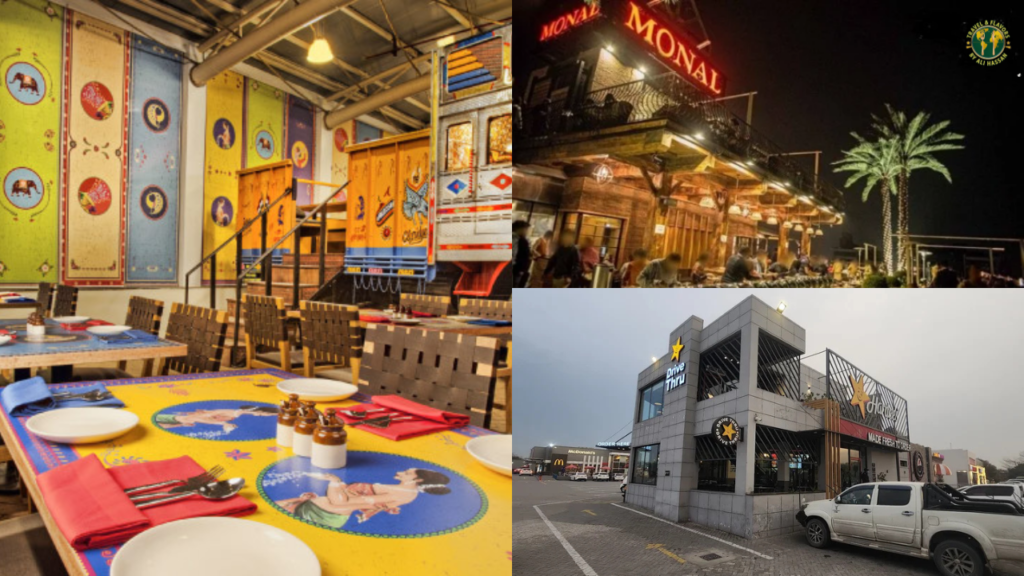
McDonald’s, KFC, Hardee’s, Subway, Pizza Hut, Dunkin’ Donuts, Gloria Jean’s, Chaaye Khana, Simply Sufi, Shanwari, Rahat Bakers, Monal Fusion — these are all operating at Bhera. There is a mosque with proper wuzu facilities, fuel stations on both sides, tyre repair workshops, ATMs, and a parking lot that is enormous on paper and still somehow full on Sunday afternoons.
The food that is actually worth stopping for at Bhera is the desi option, specifically Shanwari Karahi. The Shinwari-style karahi here is cooked fresh, arrives in a proper tawa with green chillies and tomatoes, and the naan is tandoor-baked and hot. This is the version of motorway food that justifies the detour. The portion is generous enough for two people to share comfortably, and the quality is more consistent than most of the other local options because Shanwari has enough volume at Bhera to keep the kitchen active throughout the day.
KC Grill (North Side) is worth knowing about separately. It is not a dhaba — it is a sit-down restaurant with a menu that includes Pakistani breakfast, continental options, and decent coffee. The omelette platter with paratha at KC Grill is one of the better breakfast stops on the entire route. Multiple regular M2 travellers mention that you can call KC Grill ahead of time and place your order while still on the motorway, so it is ready when you arrive. That is a genuinely useful feature if you are travelling on a tight schedule.
What does not work at Bhera: The biryani. At almost every local counter, the biryani is pre-cooked in large batches and the later in the day you arrive, the worse it gets. It is the motorway version of a dish that needs to be eaten fresh and almost never is at a service area. If you want rice-based food, you are better off with a karahi and plain rice at a proper desi counter. The biryani is almost always a mistake.
The pricing reality in 2026: Bhera is expensive. A single roti at the desi counters costs Rs. 40 to 50. A karahi for two runs Rs. 1,200 to 1,500. Fast food is standard menu pricing, which in 2026 means a meal at McDonald’s or KFC is Rs. 1,500 to 2,000 per person if you order a full combo. The “motorway tax” is real and it applies to everything including the packaged water at the tuck shops. Budget accordingly and do not be surprised.
The parking situation has gotten worse. As more food outlets opened in Bhera’s expanded plaza, parking space shrank. On busy days, travellers suggest using the overflow areas near the fuel station or arriving early. Some regular M2 drivers now deliberately skip Bhera on Friday evenings and weekend mornings for this reason alone.
One thing Bhera does better than anywhere else: late night travel. Bhera is fully operational 24 hours. If you are driving at 2am, it is the only service area where you will find hot food, proper lighting, security, and a clean washroom with any reliability. For night drivers, Bhera is non-negotiable.
Quick comparison — Bhera vs Kallar Kahar for desi food: Bhera wins on variety and late-night access. Kallar Kahar wins on food quality per rupee, atmosphere, and the overall experience of eating with a mountain view. If you can only stop once and it is daytime, Kallar Kahar is the better meal.
Kallar Kahar: The Best Dhaba Stop on Lahore Islamabad Motorway for Desi Food
Distance from Lahore: approximately 290 km
I want to say something that most motorway food guides are too cautious to say: Kallar Kahar is not just the best food stop on the M2. It is one of the best roadside food experiences in Punjab. Full stop.
At around the 290 kilometre mark, the road starts to change. The flat agricultural land that has been your view for three hours gives way to the Salt Range. The motorway begins to climb, the air temperature drops noticeably even in summer, and suddenly there are actual hills on both sides of you with the kind of green that Punjab flat land simply does not produce. The Kallar Kahar lake is visible from certain angles. The sky feels bigger somehow.
Then you pull into the service area and the chai arrives, and it is just better chai. Same leaves, same milk, same gas flame — but elevation, cooler air, and the fact that you have been driving for almost three hours all conspire to make the first sip taste like a small victory.
The food at Kallar Kahar is better than its reputation suggests. The Shinwari Karahi here is genuinely excellent — multiple food writers and regular M2 travellers consistently rank it among the best on the route. The kitchen seems to take it seriously. The karahi arrives properly oily, the tomatoes cooked down to the right consistency, the chillies whole and blistered. Eating it at an outdoor table with the Salt Range hills in the background is the kind of thing you remember months later.
There is also a Peacock Restaurant at Kallar Kahar that offers a broader menu if you are travelling with people who want different things. The outdoor seating area at the North Side overlooks the hills, and if the weather cooperates, it is the most pleasant 30 minutes you will spend on the entire drive.
What Kallar Kahar gets wrong: Pricing. The food here can be overpriced even by motorway standards, and some visitors report inconsistent service depending on how busy the day is. A few reviewers mention washroom quality as variable, and the premium Hascol washrooms (which charge Rs. 50 for entry) are consistently cleaner than the free facilities.
The safety note that matters: The stretch of M2 through the Salt Range around Kallar Kahar has gradients between 6 and 8 percent — significantly steeper than international motorway safety standards. The National Highways and Motorway Police specifically warn drivers to use lower gears rather than brakes on the downhill sections, as repeated braking causes brake failure on this stretch. A gas bowser lost control here in 2024, resulting in a tragic accident. Eat slowly at Kallar Kahar, enjoy the stop, and then drive this section carefully. Gear down before the descent. Use your brakes sparingly.
Best time to stop here: Morning arrivals (9am to 11am) and late afternoon (3pm to 5pm). The midday heat in summer makes outdoor seating less comfortable than it sounds. Monsoon season turns the hills genuinely spectacular — if you are ever on this route between July and September, the view from Kallar Kahar on a clear day after rain is worth stopping for even if you are not hungry.
Honest verdict: The single best food stop on the M2 for anyone travelling in daylight. Go for the Shinwari Karahi, sit outside if the weather allows, and do not rush.
Chakri: The Last Exit Before You Forget to Eat
Distance from Islamabad: approximately 30 to 40 km
Chakri is the final service area before the motorway ends at the Islamabad Link Road, and it exists primarily to serve two types of traveller: people who desperately need a washroom and cannot wait, and people heading back to Lahore who want to start the southbound journey with a cup of tea and a clean slate.
As a food destination, Chakri is the most limited of the five. The small cafes here serve chai, cold drinks, and basic snacks. There is no Shanwari Karahi, no KC Grill, no Dunkin’ Donuts. What there is: a quiet, spacious stop with good parking and a functional mosque.
The real question at Chakri is always the same: do you stop here, or do you push on to Islamabad and eat somewhere that has actual options? The honest answer is that Islamabad has better food within 20 minutes of the motorway exit than anything Chakri can offer. Unless someone in the car is genuinely in distress, it makes more sense to stop for fuel and a washroom break at Chakri and save the meal for the city.
One exception: If you are leaving Islamabad early in the morning for a southbound drive, Chakri is a surprisingly good first stop. The light is good, the road is quiet, and a cup of chai at Chakri at 6:30am before the long stretch south has a certain satisfying emptiness to it that the busier service areas cannot replicate.
What to Actually Order at Dhabas on the Lahore Islamabad Motorway
One thing that separates a good motorway food stop from a forgettable one is knowing what each kitchen type actually does well. Service area kitchens are not restaurant kitchens. They work at volume, under pressure, with staff that turns over. Certain dishes survive that environment and certain ones do not.
Shinwari Karahi survives and thrives. The reason is simple: it is a fast-cook dish. Tomatoes, green chillies, oil, and the meat all go in together at high heat. A competent cook can produce a good Shinwari karahi in 15 to 20 minutes. At a busy service area where the fire never goes off and the orders come in constantly, the quality of a Shinwari karahi stays consistent because the dish does not require long marination or pre-cooking. What you order is what gets made.
Biryani does not survive. It is a batch dish. It is cooked once, in a large deg, and then portioned out for hours. The first portion off a fresh deg is excellent. The portion that gets served at 3pm from a deg that was cooked at 9am is a different dish entirely. The spices flatten, the rice goes sticky, and the whole thing takes on that particular sadness of food that has been waiting too long. Every time I have ordered biryani at a motorway service area, I have regretted it. Every time I have seen someone else order it and then watched their face, I have seen the same conclusion arrive.
Daal is reliable in the way that simple things are reliable. Not exciting, not memorable, but consistently decent at most service areas. If you are travelling with someone who does not eat karahi or wants something lighter, the daal and roti option is safe at any stop.
Paratha is always the right breakfast order. At any service area, at any time of the morning, a fresh paratha made on a tawa is the most reliable item on any menu. It requires no marination, no batch cooking, no pre-preparation. It goes from dough to your plate in four minutes. Order one everywhere.
Chai from local counters beats chain coffee almost every time. Gloria Jean’s and Chaaye Khana are both available at multiple M2 stops, and both have their fans. But the karak doodh patti from the small open counter near the parking lot — the one with the blackened degh and the condensed milk tin sitting next to it — is the better cup on this road. It is made faster, it is hotter, and on a cold morning or evening, it is exactly calibrated to what your body needs after hours of driving.
Why Food at Dhabas on the Lahore Islamabad Motorway Costs More Than It Should
This section exists because every M2 food guide either ignores the pricing issue or mentions it once and moves on. The overpricing at motorway service areas in Pakistan is systematic and worth understanding, not just complaining about.
The FWO grants licences to food operators at service areas. Those operators pay significant fees for the right to run a franchise or outlet at a captive-traffic location. This is why the dhabas on the Lahore Islamabad motorway charge roughly double city rates across the board. This captive market dynamic is why a roti that costs Rs. 15 to 20 in Lahore costs Rs. 40 to 50 at Bhera, and why a cup of chai at a roadside dhaba in any Punjab city costs Rs. 50 but costs Rs. 100 on the motorway.
This is not unique to Pakistan. Motorway and highway food is overpriced everywhere in the world for exactly the same structural reason. What makes the M2 situation slightly sharper is that the price gap between city food and motorway food is larger in Pakistan than in countries where both are already expensive to begin with. For a family of four travelling the M2, a full lunch stop at Bhera can realistically cost Rs. 6,000 to 8,000. The same meal at a mid-range restaurant in Lahore would cost Rs. 2,500 to 3,500.
The practical implication: if you are budget-conscious, Sial is cheaper than Bhera simply because it has less competition for signage space and fewer premium brand outlets pushing their pricing upward. The local counters at Sial operate without the overhead of being in a high-traffic, high-rent food court, and the prices reflect that.
Practical Tips for Eating Well at Dhabas on Lahore Islamabad Motorway in 2026
On the pricing issue: There is no price regulation at M2 service areas. FWO manages the infrastructure but food outlet pricing is at the discretion of operators. In 2026, expect to pay roughly double city rates for most items. A karahi that costs Rs. 700 in Lahore will be Rs. 1,200 to 1,500 at Bhera. This is not news to regular M2 travellers, but first-timers are consistently surprised. Carry cash — smaller denomination notes are better, since some travellers report that tuck shop operators claim they cannot change Rs. 5,000 notes. ATMs are available at Bhera and Kallar Kahar but can run low on busy travel days.
On the North vs South Side difference: Most travellers only experience one side of each service area because they only drive the route one way at a time. The consistent feedback across recent reviews is that the South Side at Bhera (Islamabad to Lahore direction) is slightly better organised and cleaner than the North. At Kallar Kahar, the North Side (Lahore to Islamabad) has better outdoor seating and views. Keep this in mind when planning stops.
The M-Tag advantage: The M2 now uses M-Tag electronic toll collection at all plazas. If you travel this route regularly, having an M-Tag reduces toll stop time significantly, especially during peak hours when cash queues can back up at the plazas. This is not directly related to food, but it affects your overall timing and can mean the difference between arriving at Bhera before the lunch rush or during it.
One thing nobody puts in motorway food guides: Pack a small cooler with water and a few snacks from Lahore. Not to replace the motorway stops, but to supplement them. The prices at tuck shops for packaged water, chips, and biscuits are genuinely absurd, and having your own supplies means you are stopping for the experience and the food you actually want rather than out of thirst.
Quick Comparison
| Service Area | Distance from Lahore | Best For | Skip | Est. Spend (Full Meal) |
|---|---|---|---|---|
| Sukheki | ~90 km | Morning chai, paratha | Full desi lunch | Rs. 100 to 300 |
| Sial | ~150 km | Quiet meal, busy travel days | Nothing specific | Rs. 600 to 1,000 |
| Bhera | ~220 km | Shanwari Karahi, KC Grill breakfast, late night | Biryani, Friday evenings | Rs. 1,000 to 1,800 |
| Kallar Kahar | ~290 km | Best overall desi meal, scenic stop | Midday heat in summer | Rs. 800 to 1,400 |
| Chakri | ~345 km | Quick break, southbound morning start | Full meal (eat in Islamabad) | Rs. 100 to 400 |
What This Drive Actually Teaches You About Pakistani Road Food
The M2 is a useful crash course in something true about Pakistani highway food generally: the best dhabas on the Lahore Islamabad motorway are almost never the most famous ones. Bhera is the most famous service area on the route, and it is also the one where you are most likely to have a mediocre experience if you arrive at the wrong time and order the wrong thing.
The travellers who eat well on this drive are the ones who know that Kallar Kahar exists, that Sial on a busy day beats Bhera on a busy day, and that the Shinwari Karahi is almost always the right order at any service area that offers it.
This same principle applies beyond the M2. Pakistani road food rewards people who pay attention and ask locally rather than following the standard tourist path. If you are planning a longer road trip through Punjab, our guide to s covers some of the roadside stops that fall off the main motorway network entirely but are worth the detour.
If the M2 is just the beginning of your trip and you are heading north, the food changes dramatically once you get past Islamabad. Our piece on winter travel in Northern Pakistan covers the food culture from Murree all the way to Hunza — the chapshuro in Gilgit, the butter tea in Hunza, the things that make the northern road trip a completely different eating experience from the motorway.
Islamabad itself is worth a stop beyond the obvious. Our Islamabad guide covers the city’s food scene in detail — including the fact that the capital has some genuinely excellent desi breakfast spots that most motorway travellers drive straight past.
And if you are starting this trip from Multan rather than Lahore, or if the M2 is a leg of a longer Punjab road trip, our piece on the city of Multan covers the food that makes the southern end of Punjab worth building an entire itinerary around.
For anyone interested in how Pakistani street food culture evolved into the highway dhaba tradition, this official FWO motorway services page gives you the infrastructure side of the story — what the service areas are actually set up to provide and how the system is managed.
Final Verdict: Which Dhabas on Lahore Islamabad Motorway Are Actually Worth It
One stop. Daytime driving. The answer is Kallar Kahar.
Shinwari Karahi, outdoor seating if the weather allows, and slow enough that you actually look at the Salt Range before you get back in the car. That is the M2 food experience at its best in 2026.
If you are driving at night or you want the widest options, Bhera. But order the karahi, not the biryani, and if you can, go to KC Grill and call ahead.
If it is a peak travel day, Sial. Trust the underrated stop.
The M2 is 375 kilometres of Punjab — one of the great drives in South Asia. The dhabas on the Lahore Islamabad motorway are better than most travellers expect, not as good as the best spots in Lahore itself, and perfectly suited to the specific hunger of a long road and the Salt Range appearing on the horizon.
Drive safely through the hills. Gear down, not brake down.
Questions Travellers Actually Ask
Among all the dhabas on the Lahore Islamabad motorway, Kallar Kahar offers the best combination of food quality and experience for daytime driving. For variety, Bhera. For quiet, Sial.
Yes. All service areas on the M2 operate within Pakistan and all food outlets serve halal food.
Major chain outlets like McDonald’s, KFC, Chaaye Khana, and Gloria Jean’s accept cards. Local desi counters and tuck shops typically require cash. ATMs are available at Bhera and Kallar Kahar.
On a quiet weekday morning, 25 to 35 minutes for a proper meal. On a busy weekend afternoon, budget 45 to 60 minutes including parking, ordering, and eating.
The fast food chains have vegetarian options. At desi counters, daal and aloo dishes are available at most service areas. Kallar Kahar tends to have slightly more variety in this regard.
The paid premium washrooms at Bhera and Kallar Kahar (Hascol facilities, around Rs. 50 entry) are consistently clean. Free public washrooms vary significantly by day and traffic volume.
Have you recently driven the M2 and tried a stop that surprised you? Drop your experience in the comments below. The best motorway food tips come from people who drove it last week, not last year. And if you found this guide useful before your trip, share it with whoever is in the car with you when they ask “should we stop at Bhera?” — now you will all know the answer.
Disclaimer: Prices and quality are based on my personal experience in early 2026 and may change.

Pingback: Best Nihari in Lahore (2026): Neighborhood by Neighborhood
Pingback: Street Food in Faisalabad: A Local's Honest Guide (2026)
Pingback: Kumrat Valley 2026: Complete Guide to Pakistan's Most Underrated Mountain Paradise
Pingback: K2 Base Camp Trek 2026: Complete Guide to the World's Greatest Walk