
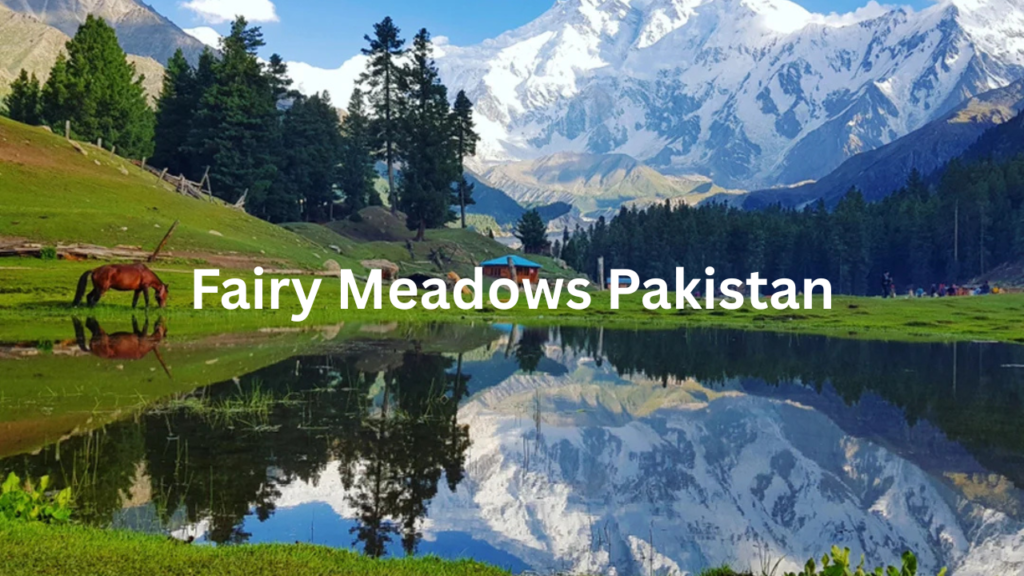

The first thing you need to know about Fairy Meadows Pakistan is that the photograph everyone has seen online is technically misleading.
The massive white wall of rock and ice rising behind the green meadow in every iconic shot is not Nanga Parbat’s actual summit. It is the North Peak, at 7,816 metres — a satellite peak of the main massif. The true summit of Nanga Parbat, at 8,126 metres, stays hidden behind the mountain’s own bulk when viewed from the meadow. You are staring at what is arguably the most dramatic wall of rock in Asia, and it is not even the highest point of the mountain you came to see. This is the kind of thing that makes Fairy Meadows more interesting, not less, but it also illustrates a pattern that runs through almost everything about this destination: the reality is both more complicated and more rewarding than the standard promotional version suggests.
Fairy Meadows Pakistan draws thousands of visitors every year, and almost all of them deal with some version of the same set of surprises. The jeep track that every guide describes as “dangerous but fine” is genuinely not something to treat lightly. The accommodation that photographs as charming rustic cabins is occasionally very basic in ways a booking screenshot will not warn you about. The crowds during peak season transform what looks like a remote alpine meadow into something closer to a busy camping ground on summer weekends.
None of this is a reason not to go. Fairy Meadows is one of the most extraordinary natural settings in Pakistan, full stop. But the experience of people who go there having read only the promotional version is meaningfully worse than the experience of people who go prepared for the actual thing.
This is the guide for the second group.
What Fairy Meadows Actually Is
Fairy Meadows is an alpine plateau sitting at approximately 3,300 metres above sea level in the Diamer District of Gilgit-Baltistan, directly below the north face of Nanga Parbat. The meadow itself is roughly 1.5 kilometres across, surrounded by dense pine forest on its lower edges and open to the full view of the Rakhiot face of Nanga Parbat on its upper side.
The name is a direct English translation of the German Märchenwiese, meaning “fairy tale meadows.” The name was given by German mountaineers during the 1930s Nanga Parbat expeditions, who set up their approach base at this plateau and found the contrast between the gentle green meadow and the savage rock face above it so extreme as to feel almost fictional.
Nanga Parbat itself stands at 8,126 metres, making it the ninth highest mountain in the world and the second highest in Pakistan after K2. Its Rakhiot face, which is what you see from Fairy Meadows, is one of the largest mountain faces on Earth. The sheer vertical relief from the meadow to the summit, roughly 4,800 metres of elevation change in a relatively short horizontal distance, produces a visual effect that photographs consistently fail to capture adequately. The mountain simply fills more of the sky than seems physically possible from ground level.
This geography — a gentle, accessible plateau with a front-row seat to one of the world’s great mountain faces — is what makes Fairy Meadows Pakistan a genuinely special destination and not just a photogenic Instagram location.
Getting There: The Part Most Guides Underexplain
Islamabad to Raikot Bridge
Raikot Bridge on the Karakoram Highway is the access point for Fairy Meadows Pakistan, sitting approximately 77 kilometres southeast of Gilgit and roughly 400 kilometres from Islamabad.
There are two road routes from Islamabad to Raikot Bridge:
Via Karakoram Highway (KKH) directly: Through Abbottabad, Mansehra, Besham, and the Kohistan region. This route is approximately 10 to 12 hours of driving and is open year-round. The Kohistan section requires a full daytime drive — standard local advice is to depart Islamabad by 4 to 5am, because the section through Kohistan has steep drops, poor lighting, and rockfall risk after dark. This is not optional caution. It is how people who do this drive regularly approach it.
Via Naran, Kaghan, and Babusar Top: More scenic, 10 to 12 hours also, but with one critical constraint: Babusar Pass sits at 4,173 metres and is closed from November through May. This route is effectively a summer-only option and is weather-dependent even in the open months. On a clear summer day it is one of the most beautiful road approaches in Pakistan. On a day when cloud has closed the pass, you will be rerouted back through the KKH anyway.
From Gilgit, buses to Chilas (which passes Raikot Bridge) leave from the main bus station at around 9am and cost approximately Rs. 1,000. The journey takes one and a half to two hours under normal conditions. Landslides along this section are not unusual, particularly after rain, and can add significant time unpredictably. Hitchhiking from Gilgit is faster if you can manage it.
Flying to Gilgit from Islamabad takes approximately one hour and cuts the ground journey significantly. The problem is the same one that applies to all mountain airport flights in Pakistan: weather-dependent cancellations are frequent. Flights to Gilgit operate under strict visibility requirements, and delays or cancellations of one to three days are commonly reported. If you fly, build that flexibility into your plan.
The Jeep Track: The 15 Kilometres Everyone Talks About
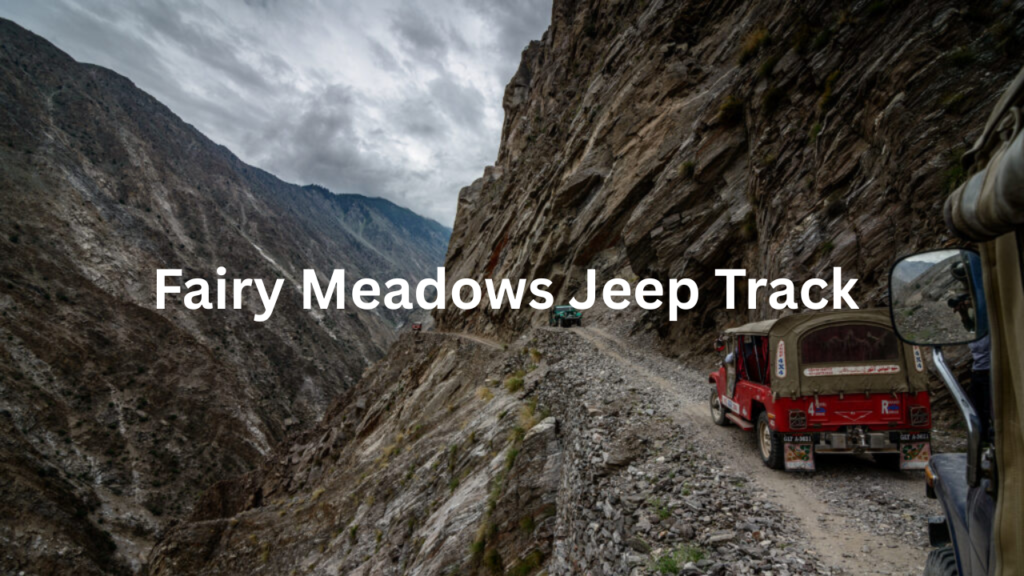
At Raikot Bridge, all privately owned vehicles stop. SUVs, 4x4s, rental cars — all of them. The 15-kilometre track to Tattu Village is operated exclusively by the local Jeep Union, and this arrangement exists for entirely practical reasons: the road ahead is carved into sheer cliffs with no guardrails, barely wide enough for one vehicle at a time, and requires specific knowledge of every turn and surface to drive safely. Only union-registered drivers who know that road intimately are permitted to operate on it.
The jeep ride costs Rs. 17,100 round-trip for a full jeep as of 2026. This is fixed and non-negotiable — attempting to negotiate will get you nowhere because the price is set by the union, not the individual driver. You can reduce your per-person cost by sharing a jeep with other travelers. Drivers will sometimes try to discourage you from sharing with strangers, but sharing is permitted and many travelers split the cost this way.
You should write down your driver’s name, licence plate number, and phone number before departing. If your return plans change and you cannot reach your driver, you may be charged again. This is a practical precaution that most first-time visitors to Fairy Meadows Pakistan learn the hard way.
The drive itself: most honest descriptions of it use words like “terrifying,” “exhilarating,” and “you will be gripping whatever you can find.” The road is unpaved, the drop on the cliff side is real, and the single-jeep-width of the track means that passing another vehicle requires extremely careful manoeuvering. Travelers who have done this ride dozens of times confirm that the drivers are genuinely expert — they know the road completely. The danger is real and the skill level is equal to it. One prior visitor noted seeing the remains of a jeep at the bottom of the ravine below a particular stretch of road. This is not a decorative detail. However, thousands of travelers make this trip safely every year.
The ride takes approximately 90 minutes from Raikot Bridge to Tattu Village.
The Trek from Tattu to Fairy Meadows
From Tattu Village, the jeep track ends and the walk begins. The distance is approximately 5 kilometres through pine forest, and the elevation gain is meaningful — you are climbing from Tattu at roughly 2,900 metres to the meadow at 3,300 metres. The trail itself is well-marked and not technically difficult, but the altitude affects everyone differently. What looks like a gentle forest path at sea level feels noticeably harder at 3,000 metres, particularly if you have come directly from Islamabad without acclimatization time.
The walk takes two to four hours depending on fitness level and pace. Porters are available at Tattu for luggage, costing approximately Rs. 1,500 to 2,000 per bag. Horses are also available for the ascent at roughly Rs. 2,000 per person, and some travelers who underestimate the trail end up taking a horse partway up. There is no shame in this. The elevation and the prior day’s journey are a real combination.
When the forest clears at the top of the trail and Fairy Meadows opens up, with Nanga Parbat filling the view in a way that no photograph has quite prepared you for, most travelers stop talking entirely for a few moments. This is the consistent detail in every account of arriving at Fairy Meadows Pakistan that has been written honestly.
The Jeep Union and the “Scam” Question
This comes up in almost every online discussion of Fairy Meadows Pakistan, so it deserves a direct answer.
The fixed jeep pricing and the restriction on private vehicles are not a scam. They are a managed system enforced by the local community for safety and livelihood reasons. The Raikot community has built their economic model around this specific service, and the road genuinely requires skilled local drivers. Travelers who arrive expecting to negotiate the price down or use their own vehicle will be disappointed, and the frustration is understandable if you were not warned in advance. But treating it as a rip-off misses the context.
What is worth being aware of: the specific advice to split the jeep cost with other travelers is sound and the drivers’ resistance to this arrangement is a negotiating tactic, not an actual rule. You are allowed to share. If you want to reduce cost, wait at Raikot Bridge and ask around for other travelers heading the same way. Groups of four splitting the jeep cost at current prices pay approximately Rs. 4,275 per person round-trip, which is a meaningfully different budget impact than paying the full jeep cost alone.
Accommodation: What You Are Actually Getting
Fairy Meadows Pakistan has two main accommodation areas that are worth understanding separately.
Fairy Meadows proper has several wooden cabin guesthouses and camping options. The most frequently mentioned are Raikot Sarai and similar cabin setups in the main meadow area. These offer simple wooden cabins with beds, blankets, and basic food. Reviews from 2025 and early 2026 are consistent on a few points: the location is extraordinary, the facilities are basic in the way that “rustic” occasionally undersells, temperatures at night drop to around 7 degrees Celsius even in summer, and hot water is at best lukewarm and sometimes unavailable. Some cabins share bathroom facilities between multiple parties without always disclosing this at booking.
If your expectation of “rustic” is a comfortable guesthouse with limited amenities, Fairy Meadows cabin accommodation generally meets that expectation. If your expectation of “rustic” involves running hot water, reliable electricity, and a private bathroom, you may want to recalibrate.
Beyal Camp, located further up the mountain at approximately 3,500 metres, is quieter, cleaner according to most recent visitor accounts, and offers a significantly better unobstructed view of Nanga Parbat. The trade-off is that it is colder at night, has even more limited facilities, and is a further walk from Tattu. Experienced visitors consistently recommend spending your first night at the main meadow for comfort and orientation, then moving to Beyal for the second night if you want the quieter and more intense experience.
The growing visitor numbers at Fairy Meadows have introduced an issue that honest guides are starting to address directly: litter. The main meadow area has suffered from waste left by visitors who arrived without adequate understanding of the carry-in, carry-out principle. This is worth being aware of both as a practical reality and as a responsibility — pack out everything you bring in, and consider the impact of your visit on a place that has no formal waste management infrastructure.
The Nanga Parbat Base Camp Extension: Is It Worth the Extra Days?
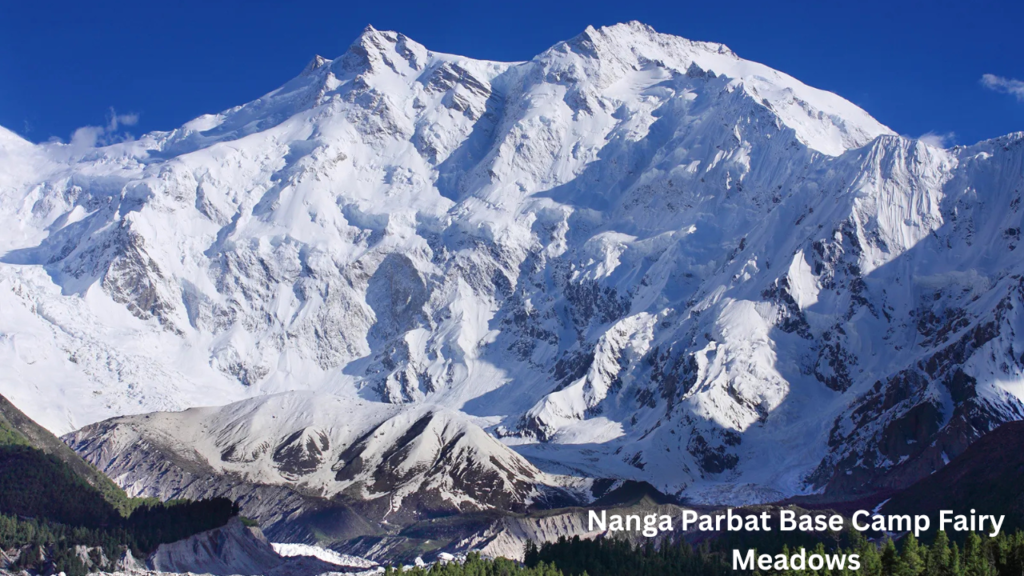
The Fairy Meadows experience can end at the meadow, or it can extend to Nanga Parbat Base Camp at Beyal, and then further to the Raikot Glacier for serious trekkers.
Fairy Meadows to Beyal Camp: This extension adds approximately 2 to 3 hours of hiking and significant additional elevation. The view from Beyal is considered by most visitors to be even more dramatic than from the meadow itself, with Nanga Parbat’s Rakhiot face closer and the Raikot Glacier visible in the foreground. This extension is achievable for reasonably fit travelers without specialized trekking experience.
Beyal Camp to Nanga Parbat Base Camp: A further half-day extension from Beyal. The route goes through increasingly rocky terrain with the glacier progressively more dominant in the view. This requires more fitness and more altitude tolerance than the meadow hike, and is not recommended for travelers who had significant altitude symptoms on the ascent.
Beyond base camp: The routes deeper into the Rakhiot valley toward the glacier and higher camps are for experienced mountaineers with proper equipment, guides, and permits. These are not casual trekking options.
For the majority of visitors who ask whether Fairy Meadows alone is worth the journey, the answer is yes without qualification. For those who want to push further, Beyal is a well-matched extension. The base camp and glacier require honest fitness and altitude assessment before committing.
Practical Details for 2026 That Most Guides Skip
SCOM SIM for mobile connectivity. Jazz, Telenor, and Zong lose coverage near Raikot Bridge and have no signal at Fairy Meadows. SCOM is the only carrier with any signal in this area. Purchase a SCOM SIM in Gilgit city before heading toward Raikot — you need your original passport and the registration takes 15 to 30 minutes. Signal at the meadow itself is weak and intermittent. Do not rely on any mobile network for navigation or emergency communication at Fairy Meadows. Download offline maps before leaving Gilgit.
No ATMs past Chilas or Gilgit. Budget Rs. 20,000 to 35,000 per person for the full trip covering the jeep, accommodation, food, porter or horse costs, and a reasonable emergency buffer. Carry more than you think you need in cash, in denominations that are usable at small guesthouses and food stalls.
Police registration at Raikot Bridge. When you arrive at the bridge, police will record your details. As of 2025, personal armed escorts for foreign visitors are no longer mandatory at Fairy Meadows, though this policy can change. Comply with registration — it is straightforward and takes a few minutes.
Nearest medical facilities are in Chilas, approximately 1.5 hours away, or Gilgit, approximately 2 hours. There are no medical facilities at Fairy Meadows or on the trail. Altitude sickness above 3,000 metres can develop quickly. If headache, nausea, or confusion worsen after arrival, descend immediately rather than waiting to see if symptoms improve overnight.
When horses pass on the trail, stand toward the mountain. Never position yourself between a passing horse and the cliff edge. This is the consistent safety instruction given to trekkers on the trail and is not decorative advice.
Season: The accessible season for Fairy Meadows Pakistan runs from approximately April to October. June through September represents the full summer window with the meadow at its greenest and temperatures manageable. May is possible but some snow may still be present on the upper sections of the trail. October becomes increasingly cold and early snow can affect the jeep track. Winter visits are possible only for experienced mountaineers with appropriate equipment — the jeep track becomes impassable under snow.
The Star-Gazing Reality That Deserves Its Own Section
Almost every traveler who stays overnight at Fairy Meadows mentions the night sky, and it is worth giving this its own space because it is one of the most consistent and genuinely extraordinary aspects of the experience.
At 3,300 metres, with no light pollution for many kilometres in every direction, the night sky at Fairy Meadows Pakistan on a clear night is among the best natural observatories most visitors will ever experience. The Milky Way is visible in a way that is genuinely difficult to communicate to people who have only seen it in photographs. Stars that are invisible from any urban environment appear. Meteor trails are common.
This is not a minor added attraction. Multiple visitors describe the night sky as a co-equal experience alongside the Nanga Parbat view, something they were not expecting to be affected by as strongly as they were. A clear night at Fairy Meadows is worth staying two nights specifically to increase the probability of experiencing it at least once without cloud cover.
How Fairy Meadows Fits Into the North Pakistan Travel Circuit
Fairy Meadows Pakistan sits at a particular point in the geography of northern Pakistan that makes it a natural component of a larger route rather than a standalone destination.
Most travelers approach Raikot Bridge either from Gilgit to the north, after a Hunza leg, or from Chilas to the south, after crossing Babusar Pass. The Hunza to Fairy Meadows sequence is the most common: Karimabad and Altit, then the KKH south past Gilgit to Raikot Bridge. Our guide to Hunza apricot season covers that valley in detail — blossom season and harvest season have completely different characters, and understanding which one you are arriving in shapes the Hunza experience before Fairy Meadows significantly.
If Skardu is part of the itinerary, most travelers either add it as a side trip from Gilgit or build it as a second northern leg after Fairy Meadows on the return south. Our Skardu in summer vs winter comparison covers that destination’s specific seasonal trade-offs, including the Deosai National Park access question that is the most consequential seasonal decision in Skardu trip planning.
For travelers approaching northern Pakistan via Chitral rather than directly up the KKH, the cultural contrast between the Hindu Kush region and the Karakoram is one of the most interesting things about the broader north Pakistan circuit. Our guide to things to do in Chitral covers that western approach including the Shandur Pass route that connects Chitral into Gilgit-Baltistan.
Almost all north Pakistan journeys originate in Islamabad, and the capital is worth real time rather than just a departure point. Our guide to things to do in Islamabad covers the city’s food and cultural scene in detail.
The food connection matters too. The journey from Islamabad to Raikot Bridge passes through the M2 service areas, and our guide to the best dhabas on the Lahore Islamabad motorway covers exactly what to eat at each stop — the Shinwari Karahi at Kallar Kahar and the KC Grill at Bhera are the last proper food options before the road north begins in earnest.
For a broader view of the north Pakistan experience beyond the main tourist circuit, our piece on winter travel in Northern Pakistan covers how the food, travel conditions, and overall atmosphere change when you move through this region in the cold months — a completely different experience from the summer Fairy Meadows visit but one that adds useful context for understanding the region as a whole.
One external resource that is worth checking before finalizing your Fairy Meadows Pakistan plans: the Gilgit-Baltistan Tourism Department maintains current road condition information and seasonal advisories that are more up-to-date than any blog, including this one. Jeep track conditions, KKH closures, and Babusar Pass opening dates all change annually, and the official source is the right place to check before committing to travel dates.
Final Honest Assessment: Fairy Meadows Pakistan
Fairy Meadows Pakistan is worth the effort. The combination of a genuinely accessible location at high altitude with a view of one of the world’s most dramatic mountain faces, pine forests, alpine meadows, and one of the best night skies available to non-technical mountain travelers in South Asia — this is a rare set of qualities in a single destination.
What it requires from you: honest physical preparation for the altitude and the trek, realistic expectations about accommodation standards, cash in sufficient quantity, flexibility in your schedule for weather and road condition variables, and some basic awareness of the jeep track reality before you get in the vehicle.
The travelers who have the worst experiences at Fairy Meadows are almost always the ones who arrived with an Instagram-filtered version of what to expect. The ones who have the best experiences are the ones who understood what they were walking into and chose it anyway.
The mountain is extraordinary. The road to get there is genuinely something. The night sky is one of the better arguments for spending a second night anywhere you will find in Pakistan. Go prepared and go with time enough to let the place do what it does.
Frequently Asked Questions: Fairy Meadows Pakistan
From Islamabad, drive or take a bus to Raikot Bridge on the Karakoram Highway, approximately 10 to 12 hours. Alternatively, fly to Gilgit (1 hour, weather-dependent) and take a bus or taxi to Raikot Bridge (1.5 to 2 hours). At the bridge, take a union jeep to Tattu Village (90 minutes), then trek 5 kilometres to the meadow (2 to 4 hours).
Rs. 17,100 round-trip for a full jeep as of 2026, set by the local Jeep Union and non-negotiable. You can share the cost with other travelers, reducing it to approximately Rs. 4,275 per person in a group of four. Write down your driver’s details before departure to avoid additional charges if your return time changes.
Yes. Fairy Meadows is considered one of Pakistan’s safer trekking regions. Police registration at Raikot Bridge is required. Foreign visitor armed escorts are no longer mandatory as of 2025, though this can change. The main risks are altitude-related illness, weather changes, and the jeep track itself, all of which are manageable with proper preparation.
June through September for the full summer experience with the meadow at peak green and accessible weather. May is possible with some residual snow on the upper trail. October becomes cold with early snowfall risk on the jeep track. Avoid November through April unless you are an experienced mountaineer with appropriate equipment.
Warm layers including a proper down jacket for nights at 3,300 metres (temperatures drop to around 7 degrees Celsius in summer), good trekking boots, rain gear, a headlamp, sunscreen for high-altitude UV exposure, sufficient cash (no ATMs past Chilas), and a SCOM SIM purchased in Gilgit for the only mobile network with coverage in the area.
The track is genuinely narrow, has a significant drop on the cliff side, and requires experienced drivers. The Jeep Union drivers know the road extremely well and thousands of travelers complete this journey safely every year. It is legitimately demanding and legitimately worth it. Describing it as “dangerous but fine” is accurate, provided the driver knows what they are doing — and the union drivers do.
Fairy Meadows is the main plateau at 3,300 metres with multiple guesthouses and campsites. Beyal Camp is further up the mountain at approximately 3,500 metres, quieter, cleaner according to most recent visitors, with an even better Nanga Parbat view but fewer facilities and colder nights. Most experienced visitors recommend a first night at Fairy Meadows, second night at Beyal, for the best of both.
Fairy Meadows Pakistan generates strong opinions among the people who have been there. If your experience confirmed or contradicted anything in this guide, or if conditions have changed since this was written, the comments section is the right place for that information. The most current and reliable Fairy Meadows advice always comes from travelers who were there in the last few weeks.

Pingback: Khunjerab Pass Complete Guide 2026: Everything Before You Go