
Here is something nobody tells you before your first serious nihari hunt in Lahore. The city does not have one nihari culture. It has at least three. And ordering the wrong type in the wrong neighborhood is the kind of mistake that haunts you for the rest of the trip.
In Old Lahore, inside the walled city, nihari is a morning ritual. The shops open before sunrise. Regulars arrive after Fajr prayers. The deg has been on the fire since midnight. By 9am, the best stuff is already thinning out and by noon, some shops simply close. If you show up at 11:30am expecting the full experience, you might get lucky or you might get the bottom of the pot.
In Mozang, Ichra, and the neighborhoods around Lahore’s middle belt, nihari runs a different schedule. These are the working-class spots where the dish evolved from its royal Mughal origins into everyday Pakistani breakfast culture. Less theatrical, more consistent, open slightly later, priced more fairly.
In Gulberg, DHA, and the newer parts of the city, nihari is a different animal entirely. Proper seating, menu cards, family sections, air conditioning, and prices that reflect all of the above. The nihari here is good. Sometimes genuinely excellent. But it is not the same dish you get at a 50-year-old shop where the owner learned the recipe from someone who learned it from someone who came from Delhi in 1947.
This guide covers the best nihari in Lahore by neighborhood, with honest notes on what each place gets right, what it gets wrong, what it actually costs in 2026, and who each spot is really for.
Why Lahore Takes Nihari More Seriously Than Almost Anywhere Else
Before the neighborhood breakdown, a short history — because understanding where nihari came from changes how you experience it.
The word nihari comes from the Arabic “nahar,” meaning morning. The dish was born in the royal kitchens of the Mughal Empire in 18th-century Old Delhi. It was originally cooked overnight in large degs and served after Fajr prayers — first to Nawabs and nobles as a high-protein morning meal, and then to the laborers who were building Mughal forts and mosques, who needed something dense enough to fuel a full day of physical work.
When Partition happened in 1947, hundreds of thousands of Muslims migrated from Delhi and Lucknow to Pakistan, settling primarily in Karachi and Lahore. They brought their recipes, their cooking techniques, and their food memory with them. Several of the families who had been cooking nihari in Old Delhi for generations set up small shops in the walled city of Lahore. That is the direct lineage of the old nihari shops that still exist in Anarkali, Lohari Gate, and Mozang today.
This is not just historical trivia. It explains why the best nihari in Lahore at the oldest shops still tastes different from any other version you will find in the city. The spice blends, the slow-cook time, the use of nalli and maghaz, the specific consistency of the gravy — these are techniques that traveled a long distance and survived intact because the people who carried them cared deeply about keeping them right.
Old Lahore: Where the Best Nihari in Lahore Actually Lives
If you are serious about finding the best nihari in Lahore, the walled city is where you start. Full stop. The streets are narrow, the parking is a problem, and on busy mornings the lane outside the famous shops is chaotic in the way that only very good food can justify. None of that is a reason to skip it.
Waris Nihari — Anarkali, New Anarkali
Waris Nihari is the name that comes up first in almost every serious conversation about the best nihari in Lahore, and the reputation is earned — but not without important caveats.
The origin story is worth knowing. The founder, Waris sahib, was originally a butcher. A guest from Delhi who was staying with him taught him the nihari recipe over a period of days and weeks. From that beginning, around 35 to 40 years ago in a narrow lane off Aabkari Road in New Anarkali, the shop grew into what it is today: the most talked-about nihari destination in the city.
What makes Waris stand out is the gravy. It is thick without being starchy, deeply spiced without being aggressively hot, and the consistency holds from the first bowl to the last in a way that suggests the recipe has been calibrated and stabilized over decades. The meat is young, which the regulars will tell you matters enormously — young beef produces a tenderness that slower-maturing meat does not.
The nalli nihari here is the order to make. The bone marrow melts into the gravy in a way that changes the texture completely. Ask for a ghee tarka on top. Eat it with their fresh naan, not the sheermaal, though the sheermaal with the last of the gravy at the end is a specific pleasure that regular visitors mention often.
The honest problems: the location is genuinely difficult to navigate, the seating is cramped and not designed for families or large groups, and the hygiene of the physical space is rough around the edges in ways that bother some visitors more than others. On busy mornings, the service slows significantly. One recent visitor described waiting a long time for food at what should be a quick-turnover breakfast spot. A small nihari costs around Rs. 900 and a full plate runs Rs. 3,000 or more, which is expensive for a dhaba-style setup. Some people feel the price is fully justified by the quality. Others feel it has gotten ahead of itself.
Go early. Weekday mornings between 7am and 9am are ideal. If you arrive after 10:30am expecting the full experience, you may find the best of the deg is already gone.
Neighborhood: New Anarkali, Old Lahore Best order: Nalli nihari with ghee tarka, fresh naan Price range 2026: Rs. 900 to 3,000+ per portion Best time: 7am to 10am, weekdays Honest rating: Food 9/10, Ambiance 3/10, Value 7/10
Muhammadi Nihari — Mozang Chowrangi and Multiple Locations
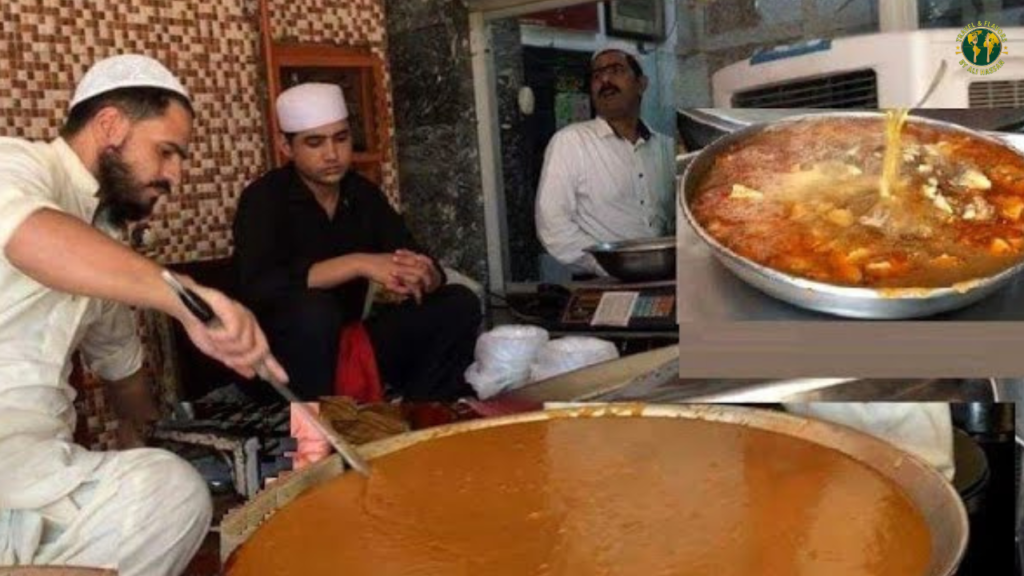
Muhammadi Nihari is the name that comes up whenever someone asks about the best nihari in Lahore but wants something more accessible than Waris. It has multiple branches across Lahore (and across Pakistan), and that consistency at scale is actually impressive given how difficult nihari is to standardize.
The Mozang Chowrangi branch is the original and still the best of them. The menu is broader than most dedicated nihari shops — fry beef nihari, special nihari, maghaz nihari, chicken nihari, nalli nihari — and each version is cooked with a desi ghee tarka that arrives separately so you can add as much or as little as you want. The spice level is high and unapologetically so. This is not nihari that has been adjusted for people who find things too spicy. It is the real thing.
What Muhammadi does better than Waris: consistency. Because it operates at higher volume and has standardized its process across branches, the quality control is tighter. You are less likely to hit a bad batch here on a busy morning. The family seating at several branches is also more comfortable than the Old Lahore alternatives.
What it does not do as well: the depth of the gravy. Muhammadi’s nihari is excellent, but it lacks the specific complexity of Waris. Regular visitors who have tried both describe Muhammadi as the more reliable everyday choice and Waris as the special occasion destination.
Neighborhood: Mozang (original), Lohari Gate branch also highly rated Best order: Nalli nihari, fry beef nihari Price range 2026: Rs. 600 to 1,200 per portion Best time: 7:30am to 11am Honest rating: Food 8/10, Consistency 9/10, Value 8/10
Haji Sahib Nihari — Lohari Gate, Walled City
Haji Sahib is the one that serious food people in Lahore mention in a slightly quieter voice, the way you mention somewhere good when you are not entirely sure you want it to get more crowded. It has been operating for over 70 years. The location is inside Lohari Gate, deep in the walled city, which means finding it requires either local knowledge or a determined navigation app.
The nihari here is different from Waris in a specific and interesting way. Where Waris has a rich, full-bodied gravy that coats everything, Haji Sahib’s version is slightly lighter and more aromatic — the fennel and ginger come through more distinctly. Some visitors prefer this. Others find it less satisfying. The menu includes beef, mutton, and chicken options, which is broader than most dedicated nihari spots.
The crowd at Haji Sahib is largely local. This is not a place that gets tourist traffic or food blogger visits at the frequency of Waris. That is precisely why the food maintains a certain groundedness. Nobody is cooking for the camera here.
Neighborhood: Lohari Gate, Walled City Best order: Special beef nihari, mutton nihari Price range 2026: Rs. 500 to 1,000 per portion Best time: Before 10am Honest rating: Food 8.5/10, Authenticity 10/10, Accessibility 5/10
Middle Lahore: Mozang, Ichra and the Working-Class Nihari Belt
The neighborhoods between the walled city and the newer parts of Lahore — Mozang, Ichra, Garhi Shahu — have their own nihari culture that is distinct from both Old Lahore and the newer restaurant areas. The shops here are slightly less famous nationally but deeply embedded in their local communities.
Bashir Darbar — Lakshmi Chowk
Bashir Darbar at Lakshmi Chowk is one of the most consistently recommended mid-city nihari spots in Lahore. It is less about the theatrics of an old walled city shop and more about a place that has quietly served the same quality for long enough that entire neighborhoods trust it.
The nihari at Bashir Darbar is cooked in the traditional style with a focus on tender meat and an aromatic gravy that is distinctly different from the Old Lahore versions. The cooking technique leans toward longer, slower preparation with a spice balance that is more nuanced than aggressive. Regulars describe it as the best nihari in Lahore for people who find Waris slightly too intense.
The location at Lakshmi Chowk also makes it significantly more accessible than the deep walled city shops, with better parking and a more organized seating setup.
Neighborhood: Lakshmi Chowk, Central Lahore Best order: Beef nihari, nalli on the side Price range 2026: Rs. 700 to 1,300 per portion Best time: 8am to noon
Allaa Nihari — Mohni Road, near United Bakery
Allaa Nihari is one of those spots that food people in Lahore know but that almost never appears in generic best-of lists. It came to wider attention through food vlogger recommendations, particularly Saqib Mobeen, whose description of it as “Allaa” in every sense has become something of a local reference.
The nihari here is buttery in a way that is unusual even for a city that takes ghee seriously. The desi ghee tarka is generous and the meat is consistently tender. The gravy has a richness that comes from long cooking time and the kind of attention to spice ratios that you cannot achieve in a hurried kitchen.
The location is not difficult — Mohni Road is accessible from most parts of central Lahore — and the prices are more reasonable than Waris while the quality is competitive.
Neighborhood: Mohni Road, Central Lahore Best order: Nihari with extra ghee tarka, fresh naan Price range 2026: Rs. 600 to 1,100 per portion Best time: 8am to noon Honest rating: Food 8.5/10, Value 9/10
Comparison: Old Lahore vs Modern Lahore Nihari
| Old Lahore Nihari (Waris, Haji Sahib) | Modern Area Nihari (Gulberg, DHA) | |
|---|---|---|
| Gravy depth | Complex, slow-developed, 12+ hour cook | Good but less layered |
| Atmosphere | Chaotic, authentic, cramped | Clean, family-friendly, comfortable |
| Price | Rs. 900 to 3,000+ | Rs. 800 to 2,000 |
| Access | Difficult, narrow streets | Easy parking, organized |
| Opening time | 6am to 10am (then quality drops) | 7:30am to 2pm |
| Best for | Serious food experience | Families, first-timers, comfort |
Gulberg and DHA: When You Want Good Nihari Without the Adventure
Not every nihari visit needs to be a journey into the walled city. Sometimes you are with family, or you need proper parking, or the children are in the car. Gulberg and DHA have answers.
Ambarsariya — Gulberg
Ambarsariya is a mid-range family restaurant in Gulberg that serves nihari alongside hareesa, maghaz, and a broader Pakistani breakfast menu. The nihari here is described by regulars as unlike others in the city — a different spice profile, softer meat, and a gravy that has a fuller flavor than most restaurant-style versions. It is served with fresh naan and sliced chillies in a clean, comfortable setting.
This is the best nihari in Lahore for families with children or visitors who want the dish without navigating Old Lahore’s breakfast chaos. The location near Mini Tower, opposite the old Mobilink building in Gulberg 2, is easy to find and accessible.
Neighborhood: Gulberg 2 Price range 2026: Rs. 900 to 1,600 per portion Best time: 8am to 1pm
Dogar Restaurant — DHA Phase 1
Dogar is primarily known for its breakfast menu and its karahi, but the nihari here has a loyal following among DHA residents who do not want to drive to Old Lahore on a weekday morning. The nihari is beefy and deep-flavored, and the option to order maghaz nihari makes it unusual among newer restaurant entrants into this space.
The DHA Phase 1 location has good parking, clean facilities, and service that is more organized than the old city shops. The price reflects the neighborhood — higher than Mozang, but competitive with other Gulberg options.
Neighborhood: DHA Phase 1 Price range 2026: Rs. 1,000 to 1,800 per portion
What Nobody Tells You About Ordering Nihari in Lahore
After visiting these places and talking to regulars, a few things become clear that no menu board will explain.
The deg matters more than the restaurant name. Nihari quality at any shop is directly tied to how fresh the deg is. A shop that opens at 5am and starts a fresh deg each night will serve better nihari at 8am than a shop that extends the previous day’s batch. When in doubt, arrive early. The first two hours of service are almost always the best.
Nalli is not optional if you care about nihari. Nalli nihari — with the bone marrow — is a completely different eating experience from plain beef nihari. The marrow dissolves into the gravy during the long cooking process and creates a richness that the meat alone cannot produce. At any shop that offers it, order nalli. It costs more. It is worth it.
Ghee tarka is a separate decision. Most shops will not automatically add the desi ghee tarka on top — you need to ask for it. Some add it as standard, others charge extra. Ask. The tarka transforms the surface of the nihari and changes the flavor in a way that makes a real difference to the first few bites.
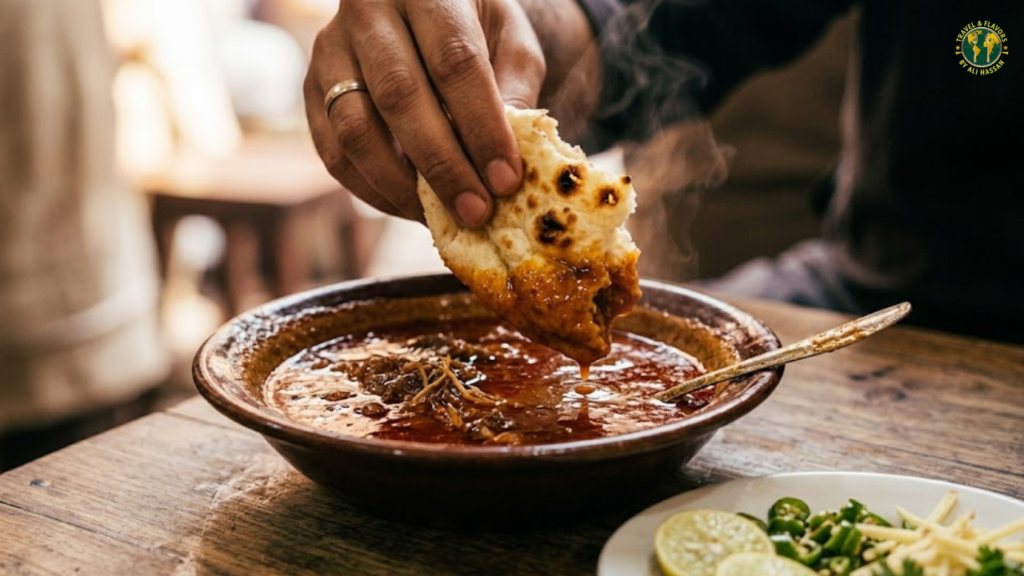
The accompaniments are not decorative. The sliced ginger, green chillies, lemon, and coriander that come with nihari are not a garnish. They are part of the dish. The acidity of the lemon cuts through the fat of the gravy. The raw ginger cleanses the palate between bites. Eat them with the nihari, not after it.
Sheermaal vs naan is a real choice. Most dedicated nihari shops serve both regular naan and sheermaal — a slightly sweet, saffron-colored flatbread. The sheermaal absorbs the nihari gravy differently from naan and creates a distinct flavor combination. Try both. The sheermaal is particularly good with the last of the gravy at the bottom of the bowl.
Practical Notes for 2026
Timing is everything. Every serious nihari shop in Lahore operates on a morning schedule. The best of the deg is gone by 10am at most Old Lahore spots. Arriving after 11am means getting whatever is left, which can be fine or can be disappointing depending on the day. If you are visiting specifically for nihari, plan your morning around it.
Cash is preferred everywhere. Even at the newer restaurant-format spots in Gulberg, the breakfast crowd at nihari shops tends to run on cash. Cards are accepted at some branches but not all. Have rupees in smaller denominations.
Prices have increased significantly since 2023. The cost of beef, ghee, and spices in Pakistan rose sharply through 2023 and 2024. What cost Rs. 400 to 500 per portion at many of these spots in 2022 now costs Rs. 700 to 1,200 at the same places. This is not price gouging — it is the direct result of inflation affecting raw material costs. Budget accordingly and do not be surprised.
Street parking in Old Lahore requires patience. The lanes around Anarkali, Lohari Gate, and Mozang are not designed for car traffic in the volumes they now receive. If you are visiting Waris or Haji Sahib on a weekend morning, leave 15 to 20 minutes extra for the parking situation. Some regular visitors use a rickshaw from a larger street and walk the last stretch.
The Lahore Nihari Experience and Pakistani Food Culture
Nihari in Lahore is not just breakfast. It is a way of organizing a morning. It is the reason people leave the house before 8am on a Sunday. It is a dish that Lahori families have very specific opinions about — which shop, which neighborhood, whose nihari is better, whose recipe has changed, whose is exactly the same as it was 30 years ago. Ask any Lahori where they go for nihari and they will tell you with the kind of certainty that people usually reserve for matters of family loyalty.
This intensity is not unique to nihari. It is part of how Lahore relates to food generally. The city has the same passion for its best food in Lahore whether it is nihari, karahi, halwa puri, or paye. Our guide to the 15 must-try dishes in Lahore covers the full scope of what the city does extraordinarily well — nihari is near the top of that list, but it is far from alone.
If the nihari hunt is part of a longer Pakistan food road trip, the dhabas on the Lahore Islamabad motorway are the next stop. Our guide to the best dhabas on the Lahore Islamabad motorway covers what to eat at each service area — the Shinwari karahi at Kallar Kahar and the KC Grill at Bhera are the food continuations of the same carnivore road trip that starts with a morning nihari in Old Lahore.
Lahore’s food culture does not exist in isolation either. The street food tradition in Karachi developed differently after Partition because the migrants who settled there came from slightly different backgrounds and brought different recipes. Our Karachi street food guide covers that parallel evolution, including how Karachi’s nihari differs from Lahore’s in specific and interesting ways.
For anyone who wants to understand Pakistani food beyond the cities, our covers the regional dishes that rarely make it into any best-of list but define the food identity of their areas as powerfully as nihari defines Lahore.
One external reference worth reading if you want the full history: the Dawn food archives on Lahore nihari history cover the origins of specific shops and the migration routes of recipes from Delhi to Lahore in more detail than almost any other source. That context makes the food taste different — better, even — when you understand how far it traveled to end up in your bowl.
Final Verdict: Where to Actually Go
One visit, serious food intent, willing to navigate Old Lahore: Waris Nihari. Go before 9am. Order nalli. Accept the chaos.
One visit, family with children, want good nihari without the adventure: Ambarsariya in Gulberg or Muhammadi Nihari at Mozang. Both deliver genuinely good nihari in settings that do not require a navigation strategy.
Regular Lahore visits, want to build a proper nihari map of the city: Start with Waris, then Haji Sahib, then Allaa Nihari, then Bashir Darbar. Each is a slightly different dish from the same tradition. Eating them in sequence is one of the better food educations this city offers.
The best nihari in Lahore is the kind of food that makes you understand why people set alarms for 6:30am on a Sunday. It is dense, deeply spiced, and completely unlike anything that sounds good on paper until you taste it. Then it makes complete sense.
Frequently Asked Questions
For the most intense and authentic experience, Waris Nihari in Anarkali is consistently at the top. For families wanting a comfortable setting with excellent food, Ambarsariya in Gulberg and Muhammadi Nihari at Mozang are the most reliable choices.
Most serious nihari shops in Old Lahore open between 5:30am and 7am. The fresh deg is best in the first two hours of service. By 10am to 11am at the oldest spots, the quality of the remaining nihari declines. Plan your visit accordingly.
Nalli nihari is nihari that includes the bone with marrow. During the long slow-cooking process, the marrow dissolves into the gravy and creates a richness that plain beef nihari does not have. It costs more but is widely considered the superior version. If a shop offers it, order it.
Prices range from Rs. 500 to 600 per portion at smaller neighborhood spots to Rs. 900 to 3,000+ at famous spots like Waris. Gulberg and DHA restaurants typically charge Rs. 900 to 1,800. Prices have risen significantly since 2023 due to inflation.
Traditionally nihari is a morning dish and the best shops reflect this with early opening hours. Some modern restaurants in Gulberg and DHA serve it through lunchtime. But the dish is at its best fresh from an overnight-cooked deg in the morning.
Lahore’s nihari culture is one of the most specific and passionate food traditions in Pakistan. If you have a shop that should be on this list, or if you think Waris is overrated or underrated, the comments section below exists for exactly this argument. And if this guide sent you in the right direction on a Sunday morning, share it with whoever else is coming.