
People who have never been to Faisalabad tend to think of it as a textile city. Which it is — it produces nearly 40 percent of Pakistan’s textile exports and has done so for decades. But what those same people tend to miss is that a city built on industrial labor develops a food culture with its own specific logic: hearty, fast, affordable, and built around the schedules of people who start working before sunrise.
Street food in Faisalabad is not fancy. It does not need to be. What it is, is honest. The halwa puri at Aminpur Bazaar that has been feeding early-morning factory workers and shopkeepers for decades. The particular version of pulao that Faisalabad calls its own, slower and sweeter than Lahore’s, cooked in a way that locals recognize immediately and outsiders are always surprised by. The samosa that you get at specific stalls in D Ground that bear no resemblance to the triangle-shaped version the rest of the world knows. The doodh patti chai that arrives at a roadside thela in a chipped cup and makes you understand why people drive 20 minutes for a specific tea seller.
I grew up in this city. I know which stalls close before 9am because they sell out and which ones are open until 2am because they only really get started after dark. This guide is the one I wish existed when I first started explaining Faisalabad’s food to people from outside the city.
The City and Its Food Logic: What Makes Faisalabad Different
Before the food spots, some context that matters.
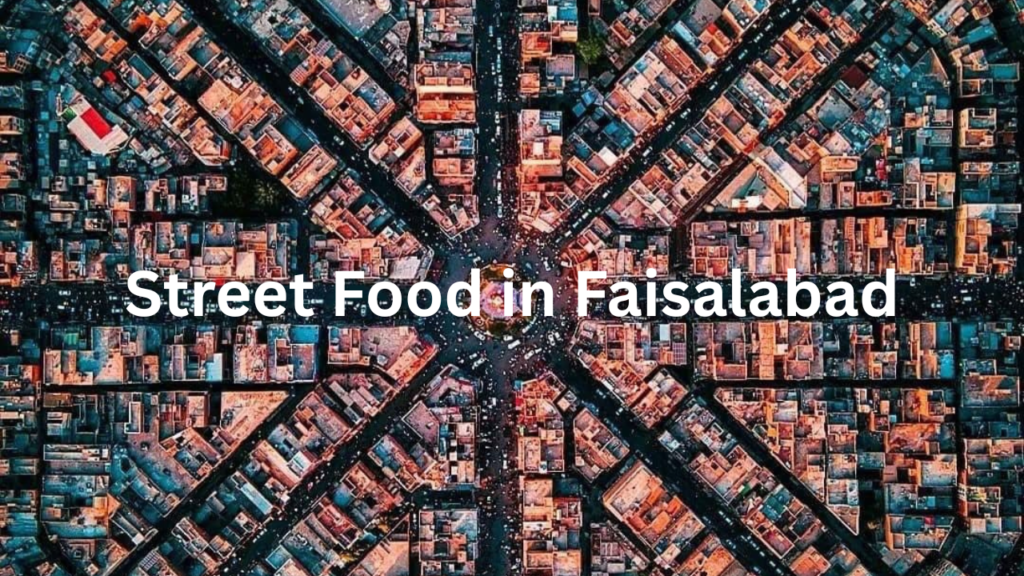
Faisalabad was founded in 1880 as Lyallpur by the British colonial administration under Sir James Lyall. It was designed as an agricultural and later industrial hub, with the famous eight-bazaar layout radiating outward from the Ghanta Ghar — the clock tower that still stands at the city’s center and remains the most recognizable landmark in the entire city.
The eight bazaars of the old city are not just commercial streets. They are the original food geography of Faisalabad. Each bazaar developed its own specialties over more than a century of operation. Aminpur Bazaar became synonymous with breakfast. Katchery Bazaar, closest to the courts, had the quick-lunch culture of people with limited time. Montgomery Bazaar developed its own sweet shop tradition. Understanding this layout helps you understand why the best street food in Faisalabad is not concentrated in one food street the way it is in Lahore or Islamabad — it is distributed across the city in ways that require local knowledge to navigate.
D Ground and People’s Colony are the modern additions to this geography — the neighborhoods that developed in the post-independence era and became the middle-class heart of the city. Today, D Ground’s food stalls, dhabas, and small restaurants represent the most concentrated street food scene in Faisalabad outside the old bazaar areas.
Morning Faisalabad: The Nashta Culture That the City Lives By
Halwa Puri in Aminpur Bazaar
If you want to understand street food in Faisalabad at its most essential, the starting point is halwa puri at Aminpur Bazaar in the early morning.
Al Mashoor Halwa Puri is the name that locals give first, and the reputation is long-standing. The puri here is the kind that should be served as a standard for the dish: properly fried, slightly thick, not oily on the surface, with a texture that holds together when you tear it into the chanay rather than disintegrating immediately. The chanay are cooked separately from the halwa and arrive with a gooey, dense texture that regulars describe as unlike what you find at most other spots in the city. The spicing is measured — present enough to be interesting, restrained enough that the chanay flavor carries through.
The unique thing about the Aminpur Bazaar halwa puri experience is the Multani puri that Al Mashoor introduced — a double-layered puri with small holes pressed into it like a roghni naan, which creates a different texture and a slightly crispier surface. Most visitors from outside the city have not seen this variation before. It is worth ordering alongside the standard puri to compare.
The seating is roadside. There are no family sections, no air conditioning, no menu cards. This is outdoor eating on plastic chairs at the edge of a bazaar that has been operating since before anyone currently eating there was born. The food is priced at Rs. 170 to 200 per plate in 2026, which makes it among the most affordable breakfast experiences in any Pakistani city.
Get there by 8am. By 9:30am, the first rush of factory workers, shopkeepers, and government office staff has already been and gone, and while the food is still good, the energy of the early morning is a different experience.
What to order: Halwa puri with chanay, try the Multani puri Price 2026: Rs. 170 to 200 per plate Best time: 7am to 9am Location: Aminpur Bazaar, old city Faisalabad
The Ghanta Ghar Morning Circuit
The area around the Ghanta Ghar — the eight-bazaar intersection that forms the historic center of the city — has its own breakfast geography. Different stalls around the clock tower specialize in different things, and a proper morning circuit of this area covers more food variety per square kilometer than almost anywhere else in Faisalabad.
The clock tower was built in 1903, its foundation stone laid by British Lieutenant Governor Sir Charles Rivaz. The city was planned on the pattern of the Union Jack, with eight bazaars radiating outward — a layout that noopener noreferrer. The News has documented as one of the most distinctive colonial-era urban designs in South Asia. What matters for food purposes is that each bazaar developed its own specialty over more than a century, and that identity extends to the food stalls that have lined each one for generations.
The area around Ghanta Ghar is particularly known for its fish. While fish might seem like an unusual breakfast food, the tradition of fried fish in the morning is deeply embedded in the old city’s food culture. Several stalls near the clock tower have been selling fish since well before the current generation of owners took over. The fish is typically rohu or singhara, marinated in a red spice paste and shallow-fried to order. Eaten with a hand-pulled paratha at 7am, it is the kind of breakfast that you eat once and then think about for weeks.
The paratha at the roadside stalls around Ghanta Ghar is also worth eating independently of the fish. The best paratha makers in this area use proper dough resting times and cook on a properly hot tawa, which produces a layered, slightly crispy result that is different from the fast paratha you get at busier modern spots.
D Ground: The Center of Modern Faisalabad Street Food
D Ground — formally People’s Colony No. 1 — is where the street food in Faisalabad concentrates for the evening and late-night crowd. From around 6pm onward, the food stalls that line the main roads through D Ground come alive in a way that feels different from the morning bazaar culture: louder, younger, more varied, and significantly busier on weekends.
Libray Naan: The One Dish Faisalabad Is Quietly Famous For
Most food guides to Faisalabad miss this entirely, which is exactly why it is worth talking about.
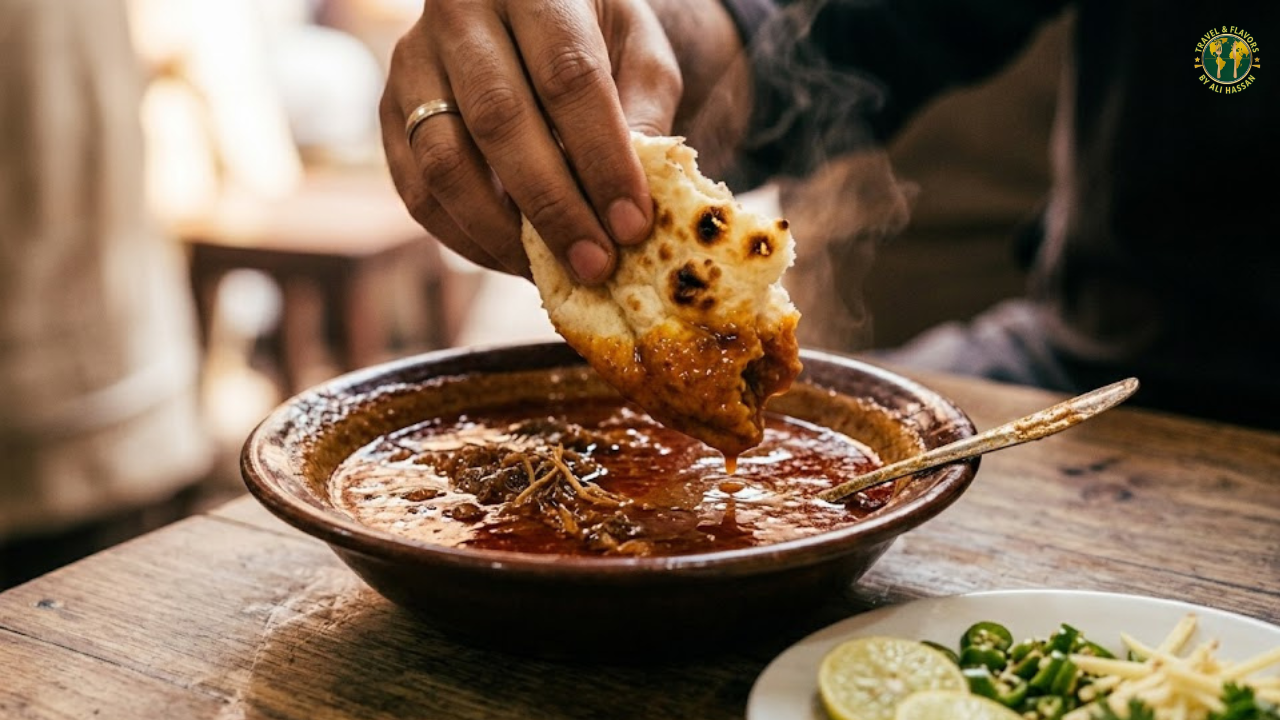
Libray Naan — the name comes from a phonetic corruption of “library,” referring to the naan shop that was originally located near an old library in the area — is a Faisalabad-specific street food that has no real equivalent anywhere else in Pakistan. It is not a naan in the conventional sense. It is a soft, thick flatbread that gets dipped into a chana gravy for several seconds, then removed, rolled briefly, and served to you with chana salad, potatoes, and spiced toppings.
The mechanics of it sound simple. The result is not. The few seconds of submersion in the chana gravy changes the texture and flavor of the naan entirely — it absorbs the spiced gravy at the surface while staying soft in the interior. The combination with the cold chana salad and warm potatoes creates a temperature and texture contrast that makes the dish genuinely addictive. Regular visitors to Faisalabad who have tried Libray Naan describe it as the single most distinctive food item in the city, the one thing you cannot find anywhere else.
The stall near D Ground that is most frequently cited is Hero Haleem and Fry Point, near Dr. Saucy in D Ground, which has become a reference point for this dish alongside its haleem. The combination of haleem and Libray Naan at the same stall is a Faisalabad-specific meal combination that locals consider essential.
What to order: Libray Naan with chanay, haleem alongside if hungry Price 2026: Rs. 150 to 300 per serving Location: D Ground area, multiple stalls near People’s Colony
Faisalabadi Pulao: The Dish That Defines the City’s Rice Culture
This is the part where most food guides to Faisalabad get it wrong. They either describe it as biryani or treat it as a minor variation on the standard pulao. It is neither.
Faisalabadi pulao is a distinctly local preparation that uses mild spices, slightly sweet rice, and sometimes chickpeas alongside the meat. The flavor profile is closer to the mild Awadhi rice tradition than to the heavily spiced biryani of Karachi or the aromatic pulao of Peshawar. Locals describe it as “subtle” — which is a word that sounds like a weakness until you eat it and realize that the subtlety is the point. The meat flavor comes through clearly because it is not competing with a dozen strong spices. The rice is soft but not mushy, with each grain separate and slightly glossy.
The best Faisalabadi pulao in the city is found at a handful of specialist stalls in D Ground and Sargodha Road area. Unlike biryani, which is a crowd-pleaser that has adapted itself to every market, Faisalabadi pulao has stayed local. It is rarely found outside the city in the same form, which makes trying it here a specifically Faisalabadi experience.
Where to find it: D Ground stalls, Sargodha Road area Price 2026: Rs. 300 to 600 per portion Best time: Lunch onward, some stalls open until late
Samosas: Not What You Think They Are
Every city in Pakistan has samosas. Faisalabad’s version is different enough that it is worth treating separately.
The samosas at the best stalls in D Ground and around the old bazaar areas are thick-crust, heavily filled, and fried at a temperature that creates a texture entirely unlike the thin-crust tourist version of the dish. The filling at the traditional stalls uses a spiced potato and lentil combination that is significantly drier than most samosa fillings — less greasy, more textured, with a spice level that builds slowly rather than hitting immediately.
The best samosa in Faisalabad, according to multiple sources, is at a specific stall in D Ground near People’s Colony that has built a following among locals who make specific trips for it. The chutney served alongside — a thin, dark tamarind and mint combination — is acidic enough to cut through the fried exterior cleanly.
The Pathoray Question: Jalandri vs Standard
This section exists because Faisalabad has a specific and ongoing conversation among its food people about which pathoray are the best, and that conversation deserves documentation.
A pathoray is a thick, deep-fried bread traditionally served with chanay — a relative of the puri but coarser, chewier, and more substantial. The standard version is what you find everywhere. Jalandri Pathoray — named after the Jalandhar style that migrated to Faisalabad with partition-era refugees from the Indian Punjab — is the specialty version that food people in the city prefer.
What makes Jalandri Pathoray different: the chanay are oil-free. The shop that specializes in this style in Faisalabad claims, and regular visitors confirm, that the chanay are cooked without a single drop of oil added. The result is lighter than expected, with a cleaner chickpea flavor that the oiled version cannot replicate. The pathoray themselves are thick and rich in flavor — the oil-free chanay creates a balance where neither element dominates.
This makes Jalandri Pathoray an interesting choice for people who find regular halwa puri or pathoray too heavy: same dish category, meaningfully different eating experience.
Location: Multiple stalls in old bazaar areas; ask locals for the current best Price 2026: Rs. 150 to 250 per serving
Evening and Late Night: Where Street Food in Faisalabad Gets Interesting
Hazara ki Daal: The Tarka Daal That Has Its Own Loyal Following
Among the evening street food spots in Faisalabad, Hazara ki Daal occupies a specific position. It is a roadside restaurant on Halal-e-Ahmar Chowk, State Bank Road, that serves tarka daal in pure desi ghee along with a handful of other items including chicken korma deghi style, anda daal, and white jalfrezi.
The daal here is not a side dish. It is the main event. The tarka applied in pure desi ghee gives the daal a depth and richness that the vegetable oil versions served elsewhere cannot replicate. The seating is roadside with ample space, which makes it better for groups than the cramped old bazaar spots. Regulars visit specifically for this daal and little else, which is the most reliable indicator of a dish worth trying.
What to order: Plain tarka daal with desi ghee, anda daal as a variation Location: Halal-e-Ahmar Chowk, State Bank Road
Chai Culture in Faisalabad: The Roadside Thela Tradition
No guide to street food in Faisalabad is complete without the chai. And Faisalabad’s chai culture deserves its own entry because it is more specific than most cities.
The doodh patti tradition in Faisalabad runs on particular ratios — more milk than most Pakistani chai, longer boil time, and a specific tradition of adding green cardamom at the end of the cooking rather than the beginning, which produces a fresher cardamom flavor in the cup. The roadside thelas that specialize in this style are spread across the city, but the D Ground area and the older bazaar zones have the highest concentration of the best ones.
The chai at these thelas comes in cheenki cups — small, handle-free ceramic cups that hold just enough for a proper sip. The price is Rs. 50 to 80 per cup in 2026 and has not risen as sharply as restaurant tea because the thela operators are working with minimal overhead and genuine competition from the stall 15 feet away.
The best time for roadside chai in Faisalabad is between 9pm and midnight, when the evening crowd has thinned but the thelas are still running at full pace. A cup of chai at that hour, at a stall that has been operating in the same spot for longer than you have been alive, is the kind of simple experience that stays with you longer than anything more complicated.
Faisalabad Food Compared to Its Punjab Neighbours
Faisalabad’s street food occupies an interesting position in the Punjab food geography. It is not as theatrical as Lahore, not as frontier-influenced as Peshawar, not as seafood-heavy as Karachi. What it is, is deeply Central Punjab in character: wheat-based, meat-heavy at dinner, dairy-rich in the morning, and built on traditions that came partly from the city’s pre-partition agricultural roots and partly from the post-partition migration of families from East Punjab who brought their own recipes.
The comparison to Lahore is inevitable given the proximity, but the food cultures are different enough that you cannot substitute one for the other. Our guide to the best food in Lahore covers that city’s specific character — the nihari culture, the street food geography, the dishes that are uniquely Lahori. Faisalabad’s equivalents are not lesser versions of the same food. They are a parallel development with their own logic.
For those travelling through Punjab and using the M2 as the main spine of the trip, our guide to the best dhabas on the Lahore Islamabad motorway covers the food stops between the two cities. Faisalabad sits off the M2 but connects via the M-4, which has its own emerging food stop culture worth watching.
Islamabad, the usual endpoint of a Punjab road trip, has a food scene that surprises people who expect a government city to be culinarily dull. Our guide on things to do in Islamabad covers what the capital does well for food — and the comparison with Faisalabad is illuminating.
If the Punjab food experience has made you curious about how Pakistani street food culture compares to what exists elsewhere in the country, our Karachi street food guide covers that city’s very different food identity — a coastal, more cosmopolitan tradition that shares ancestry with Faisalabad’s in some dishes and diverges completely in others.
For a broader view of what Pakistan’s food culture looks like when you move outside the cities and into the less-documented areas, our covers some of the regional dishes that rarely appear in any guide but define the food identity of their areas as strongly as Libray Naan defines Faisalabad.
What a First-Timer Should Eat in Faisalabad: A Practical Order
If you have one day in the city and you want to cover the essential street food in Faisalabad in a logical sequence, here is the order that makes sense:
Start at 7:30am at Aminpur Bazaar for halwa puri. The Multani puri, if available. Chanay on the side. Eat slowly.
Mid-morning, walk or drive to the Ghanta Ghar area. The fish stalls if they are running. At minimum, a paratha with chai from one of the roadside stalls near the clock tower.
Afternoon in D Ground. Faisalabadi pulao for lunch at one of the specialist stalls. This is the dish that will require asking a local to point you to the right place — generic searching will send you to restaurant-format spots that do an approximation. Ask someone who actually lives in People’s Colony.
Evening back in D Ground. Libray Naan at Hero Haleem and Fry Point. Haleem alongside. This is the meal that will make the most sense of everything else you ate during the day — it is the point at which Faisalabad’s street food stops feeling like generic Punjab food and starts feeling specific to this city.
Late evening, anywhere that has a proper roadside thela running. Doodh patti chai. Sit with it for 20 minutes. Watch the city wind down.
That is a full Faisalabad food day. It costs somewhere between Rs. 1,500 and 2,500 for one person eating properly at each stop. It covers the city’s food culture more completely than any restaurant could.
Sweets and Desserts: The Part of Street Food in Faisalabad That Gets Overlooked
A guide to street food in Faisalabad that skips the sweets is missing a significant part of the picture. The city has a serious mithai culture that operates alongside the savory street food scene and is worth knowing about.
Gol Gappay at D Ground: Gol gappay in Faisalabad are slightly larger than the Lahore version and the pani tends to be more tamarind-forward and less mint-heavy. The best stalls in D Ground serve them with a separate sweet imli chutney on the side rather than mixed into the pani, which gives you more control over the flavor balance. The filling of spiced potatoes and chickpeas is denser than most city versions. Price in 2026: Rs. 20 to 30 per piece.
Kohinoor Kulfi Falooda: One of the more well-known dessert spots in the city, Kohinoor Kulfi Falooda near D Ground has been serving the falooda-kulfi combination long enough that its name has become almost generic in local conversation. The kulfi here is denser and less sweet than the commercial versions, and the falooda noodles are properly thin rather than the starchy thick version that lower-quality spots use. On a summer evening in Faisalabad, when the temperature is still above 35 degrees at 9pm, a kulfi falooda at Kohinoor is both practical and delicious.
Jalebi in the old bazaar areas: The fresh jalebi made at the older sweet shops around Aminpur Bazaar and Katchery Bazaar in the early morning hours is a different product from the pre-made jalebi that sits in trays at modern shops. It comes out of the oil at a temperature that keeps the sugar syrup liquid inside the crispy exterior, and eating it within two minutes of leaving the oil is the only way to experience it properly. After that, the texture changes. Morning jalebi with chai is one of the simplest and most satisfying things you can eat in this city.
Practical Notes for 2026
Cash is the only currency that works. Not a single street food stall in Faisalabad’s traditional areas accepts card payment. Even newer D Ground spots are primarily cash operations. Carry small denominations — Rs. 500 notes are fine, Rs. 5,000 notes are a problem at a chai thela.
Morning spots close before noon. The halwa puri spots, the fish stalls near Ghanta Ghar, and the paratha makers around the old bazaar area operate on a morning schedule. They are not open at 2pm. If you are visiting Faisalabad primarily for the morning food culture, plan accordingly.
D Ground on weekends is significantly busier. Friday evenings and Saturday nights in D Ground have a crowd level that makes finding a spot or getting quick service more difficult. Weekday evenings are calmer and often produce a better eating experience.
The city’s food geography requires local guidance for specific stalls. Unlike Lahore, where famous spots have addresses that work on navigation apps, the best street food in Faisalabad is often at stalls and small shops that do not have registered addresses. The best navigation strategy is to ask locals in each neighborhood rather than relying on Google Maps alone.
Frequently Asked Questions
Libray Naan is the most distinctly Faisalabadi street food — a dish that does not exist in the same form anywhere else in Pakistan. Halwa puri at Aminpur Bazaar and Faisalabadi pulao are the other essentials.
Yes, significantly more affordable than Lahore or Islamabad equivalents. A full halwa puri breakfast costs Rs. 170 to 200. An evening Libray Naan meal runs Rs. 150 to 300. Even a proper pulao lunch stays under Rs. 600. A complete food day covering all the major stops costs Rs. 1,500 to 2,500 per person.
Morning spots around Aminpur Bazaar and Ghanta Ghar open by 6:30am to 7am and typically close by noon. D Ground evening stalls begin around 6pm and run until midnight or later on busy nights.
For Pakistani food travelers, yes. The specific dishes — Libray Naan, Faisalabadi pulao, Jalandri Pathoray — are not available in the same authentic form outside the city. For a day trip from Lahore or a stop on a Punjab road trip, the food alone justifies the detour.