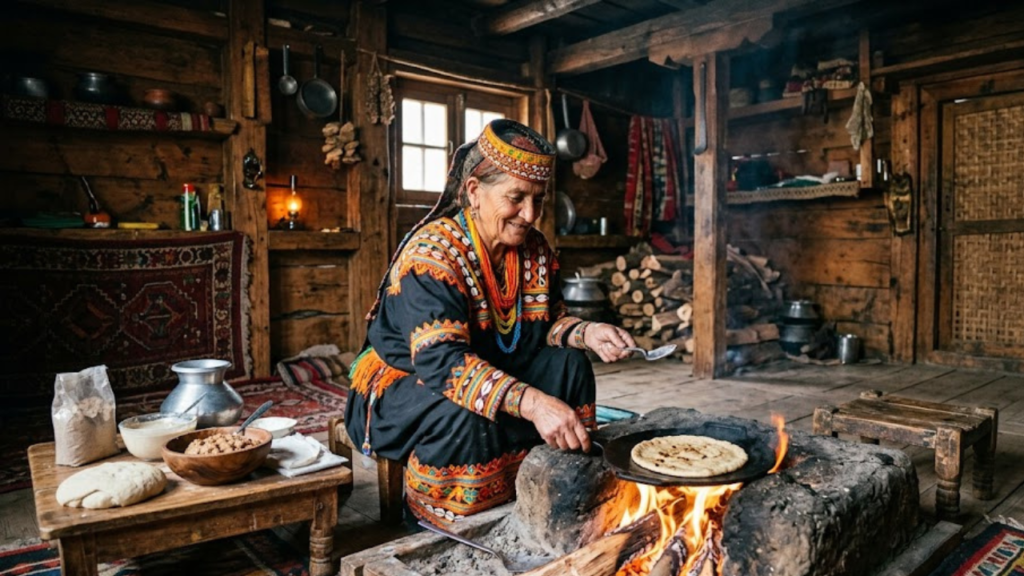

Every travel guide to Chitral mentions the Kalash people. Most of them describe the colorful headdresses, the polytheistic religion, the three festivals. Almost none of them seriously cover the food — and when they do, it is usually a generic bullet list of dishes that could apply to any mountain community in the Hindu Kush.
This guide exists to fill that gap.
Kalash Valley food is one of the most distinctive food cultures in South Asia, and it has almost nothing in common with the Pakistani cuisine most visitors know. The Kalash people, numbering approximately 3,000 to 4,000 individuals across the Bumburet, Rumbur, and Birir valleys, have maintained a food culture rooted in walnut groves, grape vineyards, mountain cheese, and goat husbandry for centuries. Their staple ingredients — walnuts, grapes, millet, wheat, apricots, and fresh mountain cheese — form a diet that would feel more familiar to a Central Asian nomad or an ancient Greek Dardic tribesman than to anyone from the Pakistani plains.
But there is a complication that most food guides to this region completely miss: the Kalash food culture and the Kho (Chitrali) food culture are different from each other, and both are worth understanding separately. Chitral town and its surrounding valleys have their own distinct cuisine — shorba, chapshuro, ghalmandi, and the specific tea culture of the Kho people — that runs parallel to but distinct from what you eat in Bumburet or Rumbur.
Understanding both, and understanding what connects them, tells you more about the food of this region than any generic “best foods of Chitral” list ever could.
Why Kalash Valley Food Is Unlike Anything Else in Pakistan
The starting point is geography and religion combined, because in the Kalash Valleys these two things are inseparable from each other and both directly shape the food.
The Kalash valleys sit between 1,900 and 2,200 metres above sea level, fed by glacial streams and surrounded by mountain slopes dense enough to support walnut trees, mulberry trees, apricot orchards, and the grape vineyards that make the Kalash the only community in Pakistan that maintains a living winemaking tradition. The high altitude and the specific microclimate of the Hindu Kush foothills produce fruit and nuts of exceptional quality — the same principle that makes Hunza Valley apricots famous applies here with equal force to Kalash walnuts and grapes.
The religious dimension matters for food in ways that outsiders rarely understand before visiting. The Kalash practice a polytheistic religion with strict concepts of purity and impurity that permeate every aspect of daily life, including food production and consumption. Certain animals are ritually pure and others are not. Certain spaces are for the preparation and consumption of pure food and others are not. Women who are considered impure during specific periods are restricted from the main food preparation areas. Goats and their products — milk, cheese, and meat — are considered pure and occupy a central place in Kalash ritual and daily diet in a way that extends far beyond their nutritional value.
This is not a culture where food is simply fuel. In the Kalash Valleys, almost every significant food has a ritual dimension, a connection to a specific festival, or a place in the annual agricultural cycle that gives it meaning beyond the plate.
The Bread Culture: Walnuts in Everything
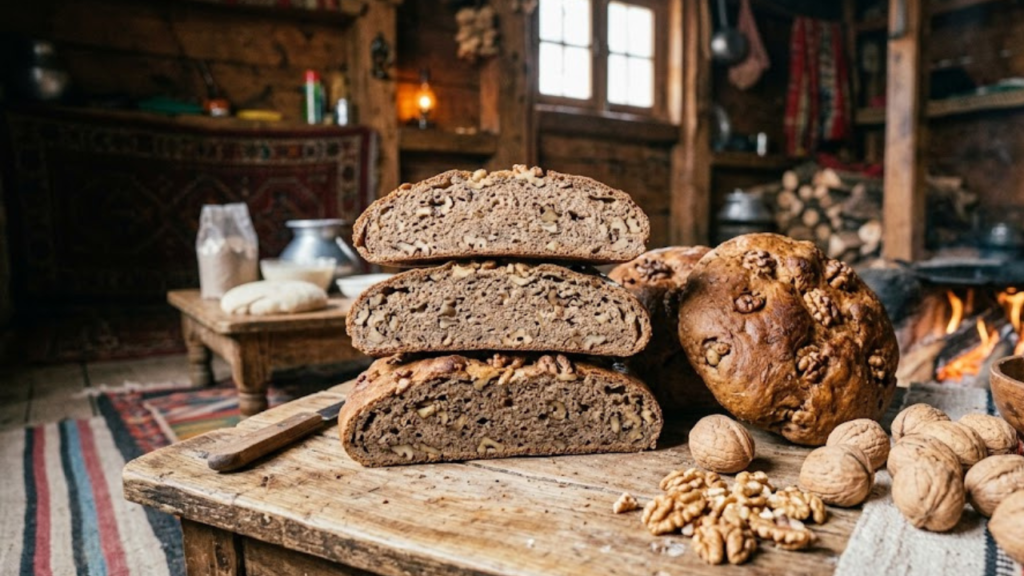
If you visit the Kalash Valleys and eat with a local family even once, the first thing you will notice is the bread, and the second thing you will notice is that almost every bread contains walnuts.
This is not coincidence and not simply a matter of local preference. Walnut trees are among the most important agricultural resources in the Kalash Valleys. They grow large and old here — some trees in Bumburet and Birir are several centuries old. The nuts are harvested in autumn, dried, shelled, and incorporated into bread, used as snacks, pressed into oil, and paired with dried apricots for a combination that appears throughout the year in both daily meals and festival contexts. The walnut-apricot pairing is so embedded in Kalash food culture that it functions as the region’s equivalent of a staple dish: available at every household, produced locally, and eaten without ceremony throughout the day.
The specific Kalash breads worth knowing before you visit:
Bilili is the most widely eaten Kalash bread, made from a batter of wheat flour and crushed walnuts cooked on a flat pan. The result is denser and oilier than a standard flatbread, with a nutty flavor that becomes the backdrop for butter, local honey, or cheese. It is eaten at breakfast, as a snack, and alongside meals with no specific occasion required.
Ja’u is a thick bread stuffed with walnuts and sometimes cheese, baked directly beside a fire rather than on a pan. The fire-baking gives the exterior a slight char while the interior stays soft, and the walnut filling provides a texture that is unlike anything in mainstream Pakistani bread culture. Ja’u is more time-consuming to make than bilili and tends to appear at meals where guests are being honored or during festival preparations.
Kurau uses grape juice, locally referred to in the same terms as wine, as part of the flour mixture. The grape juice fermentation slightly affects the dough, producing a bread that has a faint sour note under the nuttiness. It is specific to the Kalash and has no equivalent in any neighboring food culture.
Tewreshak is a simpler bread — a flatbread topped with clarified butter and salt — that functions as the everyday working person’s bread. It is fast to make, requires minimal ingredients, and serves as the vehicle for whatever is being eaten alongside it.
Tasili is an unleavened flat round bread without yeast, the closest Kalash equivalent to a chapati, though made with local wheat that produces a slightly coarser texture than the refined flour equivalent in the plains.
The bread culture in the Kalash Valleys is preserved almost entirely through household practice. There are no bakeries. There are no restaurants serving these breads to tourists in the way that restaurants in Lahore serve nihari or karahi. The only way to eat authentic Kalash bread is to eat with a Kalash family, either through a homestay arrangement or through a guesthouse owned by a Kalash family. In Rumbur and Birir particularly, where the tourist infrastructure is less developed than in Bumburet, homestay meals produce the most genuine food experience available to any visitor.
Cheese, Goats and the Purity System
The Kalash cheese tradition is another dimension of Kalash Valley food that is almost entirely absent from travel coverage of the region, which is remarkable given how central dairy is to the culture.
Goats are the primary livestock of the Kalash Valleys. They are considered ritually pure animals under Kalash religious rules and are central to both daily food production and sacrificial ceremonies at all three major festivals. Goat milk is consumed fresh, fermented into a specific sour dairy product, and made into a fresh cheese that appears alongside almost every meal in the valleys.
The fresh cheese produced in the Kalash Valleys is similar in character to a simple cottage cheese or paneer — unaged, white, mild, and slightly salty. It is made by curdling goat milk with a natural acidifier, then pressing the curds into rounds that are consumed within a few days of production. During festival periods, particularly Chaumos in December, the offering of cheese to deities and ancestors is a specific ritual act, not simply a dietary choice. The cheese is presented at the Jeshtak shrines — sacred spaces dedicated to the ancestors — as part of the ceremony of gratitude for the completed harvest.
The fresh cheese paired with bilili walnut bread and local honey is the Kalash meal that visitors most consistently describe as unexpectedly delicious. The combination sounds simple to the point of austerity. In practice, when the cheese is fresh from that morning and the honey is raw mountain honey from hives kept in the walnut orchards, it is one of those eating experiences that does not transfer to a restaurant setting and cannot be replicated anywhere else.
Kalash Wine: The Food Dimension That Nobody Covers Properly
The Kalash winemaking tradition is the single most discussed aspect of Kalash culture in international travel writing and simultaneously the least well explained. Most articles note that the Kalash make and drink wine, which is unusual in a Pakistani context, and move on. The food and ritual dimensions of the wine are almost never covered.
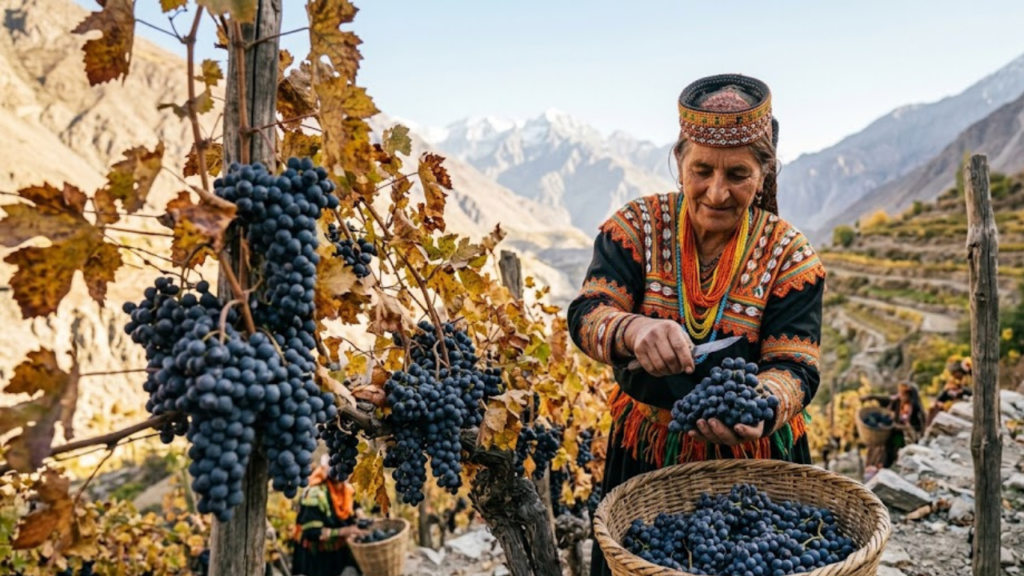
The Kalash grape harvest happens in autumn, primarily in October, with Birir Valley having the strictest harvest protocols. Grape-picking in Birir is prohibited until the fruit has reached full ripeness — a community regulation that has become more significant as climate change-induced glacial flooding has reduced vineyard yields in recent years. The grapes grown in the valleys are dark and small, producing a juice that is described by those who have tasted the finished wine as tart and sweet simultaneously, with a sharpness that commercial wine does not replicate.
The harvested grapes are collected in large wooden troughs. Virgin boys and men climb in and trample the grapes with bare feet that have been ceremonially cleaned beforehand — the purity concept applies here as directly as it does to any other Kalash food preparation. The juice is filtered through a household strainer, then stored in airtight plastic drums (traditionally sealed clay vessels) to ferment for approximately one month. The finished wine, called da in the Kalash language, is tart, slightly effervescent from active fermentation, and anywhere from mildly to significantly alcoholic depending on the specific fermentation duration.
The wine’s role in Kalash Valley food culture is not primarily about pleasure, though the pleasure dimension is real and acknowledged freely by Kalash community members. It is fundamentally a ritual substance. At Chaumos, the wine is offered at shrines alongside food. At Chilam Joshi in May and Uchal in August, the communal sharing of wine during the festival periods is an act of social and religious cohesion rather than simply celebration. The Kalash wine tradition is one of the last surviving pre-Islamic winemaking cultures on the Indian subcontinent and represents an unbroken connection to the food practices of an ancient mountain civilization that converted to Islam everywhere except these three valleys.
Visitors who ask honestly are usually offered wine by Kalash host families. Accepting it respectfully, understanding its context, and not treating it as a curiosity for photographs is the appropriate response. The wine is not a tourist attraction. It is a living practice with religious significance.
Capuche and Khar: The Soups That Define Winter
In a high-altitude mountain environment where winters drop below freezing and the snow can reach significant depths in the upper valley areas, the soup culture of the Kalash Valleys is not comfort food in the modern sense. It is survival food that became comfort food over generations because it works.
Capuche (sometimes transliterated as Capuče) is a warm soup made from millet flour mixed with water and simmered to a thick, porridge-like consistency. It is the Kalash equivalent of what barley gruel was to medieval Europeans or what tsampa is to Tibetan communities — the high-calorie, easily stored, quickly prepared staple that keeps people functional in difficult winter conditions. Millet grows in the Kalash Valleys at elevations that wheat sometimes struggles with, making it a reliable crop where other grains are marginal. Capuche has a mild, slightly earthy flavor that accepts butter, honey, or dried fruit additions easily. In winter months it appears multiple times per day in some households.
Khar is a Chitrali soup found in both the Kho communities of Chitral town and the surrounding valleys, though slightly different versions appear in the Kalash Valleys as well. It is made with buttermilk as the base, with vegetables — turnips, spinach, or radishes depending on the season — and sometimes lentils, flavored with local spices and simmered to a tangy, nutritious consistency. The buttermilk base gives khar a sourness that distinguishes it from any other soup in the region. It is described by the Wikipedia entry on Chitrali cuisine as one of the foundational soups of the area, alongside kalli, a broth-based soup with noodles or vegetables.
Chitrali Food: The Kho Cuisine That Runs Parallel to Kalash
The Kho people are the majority community of Chitral, Muslim, speaking Khowar, and maintaining their own distinct food culture that shares some ingredients with Kalash food but diverges significantly in its dishes, its tea culture, and its relationship to the regional culinary traditions of Central Asia and Afghanistan.
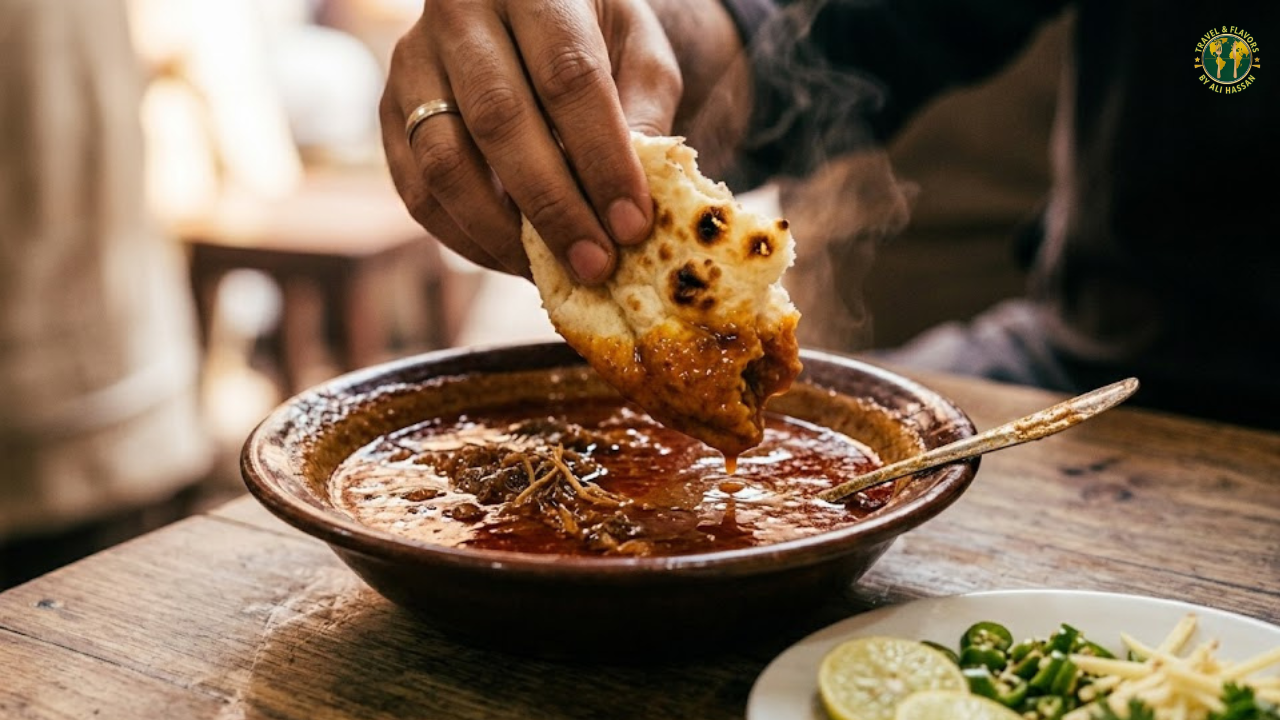
Shorba is the foundational Chitrali dish and deserves the same kind of detailed treatment that nihari gets in Lahore. It is a slow-cooked broth of lamb or goat on the bone, simmered for several hours with onion, dried tomato, whole spices, and wild mountain herbs that grow in the surrounding hills. The cooking time collapses the meat off the bone and builds a broth that is rich with collagen, deeply savory, and unlike anything produced by a short-cooked curry. Shorba is eaten at weddings, at funerals, at celebrations, and at ordinary winter dinners. It is served in large communal bowls with freshly baked wheat bread for dipping and breaking into the broth. The bread and broth combination makes the dish complete and deeply filling without requiring anything else. If you eat only one thing in Chitral town, make it shorba from a family meal context rather than a tourist restaurant approximation.
Chapshuro is the dish that Chitral Hive accurately calls the “Chitrali pizza” — a flatbread stuffed with spiced minced meat, onions, coriander, and green chilli, cooked on a tawa until golden and crisp on both sides. Each valley and family has its own variation: some add wild leeks, others fold dried apricot into the filling to balance the heat of the chilli, and some families in the upper valleys make a version with cheese instead of meat. Chapshuro travels well, keeps for hours without refrigeration, and appears at every gathering from the Shandur Polo Festival to ordinary packed lunches. It is the food that Chitrali men take on mountain journeys for exactly the same reason Roman soldiers carried hardtack — calorie-dense, durable, and genuinely good when made properly.
Ghalmandi is the Chitrali flatbread, distinct from chapshuro by the absence of filling. It is made with locally milled wheat or maize flour and cooked on a tawa or directly on hot embers. The maize version — makai ki roti in the local parlance — has a coarser texture and a slightly sweet corn flavor that pairs well with butter and honey or with the sour milk products common in the region. Ghalmandi is the bread of daily life in Chitral in the way that roti is in Punjab, but the flour base and the cooking method produce something with a distinctly different character.
Chitrali Pulao deserves special mention because it differs from the Faisalabadi or Lahori versions in a specific and important way. Chitral’s pilaf is cooked in pure yakhni — a clear, aromatic stock of lamb or chicken with whole spices — rather than tomato-based sauce or simple water. The rice absorbs the stock as it cooks, turning translucent and fragrant. It is then topped with slow-cooked meat, crispy fried onions, and scattered with roasted pine nuts and raisins. Pine nuts from the surrounding forests are an ingredient that does not appear in plains Pakistani cooking and gives the Chitrali pulao a flavor dimension that makes it distinct. It is the celebratory dish of the Kho community and its presence at a meal signals a formal occasion.
Mantu — the Central Asian dumpling found across the Silk Road from Turkey to China — is popular in Chitral in a form that reflects the Uzbek and Tajik influences that entered the region through the Afghan border trade routes. The Chitrali mantu is a steamed dumpling filled with spiced meat and onion, served with a yogurt sauce and sometimes a tomato-based topping. Its presence on Chitrali tables is a direct culinary artifact of the trade and cultural connections between Chitral and Central Asia that predated the modern international borders.
The Tea Cultures: Salty Butter Tea vs Troq Chai vs Green Tea
Nowhere in Pakistani food culture is the difference between Chitrali food and the rest of the country more stark than in the tea.
Salty butter tea — made by boiling black tea leaves, adding salt and butter or ghee, then churning or shaking the mixture to combine it — is consumed daily in Chitral as a warming, high-calorie beverage suited to the cold mountain environment. The concept is identical to the Tibetan butter tea and the Hunza gurgur chai: fat and salt replace sugar as the flavoring agents, and the result is savory rather than sweet, thick rather than thin, and genuinely sustaining in a way that plain black tea is not. First-time visitors from the plains almost universally find the taste strange at first encounter. Most of them describe finding it oddly compelling by the second or third cup, particularly when consumed at altitude after physical exertion.
Troq chai, meaning “bitter tea” in Khowar, is a strongly brewed black tea without milk or sugar — a complete contrast to the creamy doodh patti consumed everywhere in Punjab. It is drunk as a digestive, as an accompaniment to fatty foods, and as a morning ritual in its own right. The bitterness is genuine and not an acquired taste so much as a cultural preference developed in a region where tea is not primarily a social lubricant but a functional part of the meal.
Green tea is the most widely consumed tea in Chitral for daily occasions without the ceremony of butter tea or the austerity of troq chai. It is drunk with meals, between meals, and as a hospitality offering to guests in the same way that a Lahori household offers chai. The green tea of Chitral is typically unspiced and drunk without milk, which again distinguishes it from the cardamom and ginger inflected versions common further south.
The contrast between these three tea cultures in a single district is a useful summary of how layered Chitrali food actually is — each tradition serving a different function, each reflecting a different aspect of the region’s history, climate, and cultural connections.
Festival Food: When Kalash Valley Food Becomes Ritual
The three Kalash festivals — Chilam Joshi in May, Uchal in August, and Chaumos in December — are the occasions when Kalash Valley food moves from daily sustenance into ritual significance, and understanding this dimension changes how you experience any food-related encounter during a festival visit.
Chilam Joshi celebrates the return of flocks from winter pastures and the beginning of the agricultural cycle. Fresh dairy products — particularly the new season’s cheese and fresh milk — are central to the celebration because they mark the beginning of productive abundance after the winter period of preserved food. The ritual offering of milk to the Mahandeo shrine is the ceremonial acknowledgment that the goat herds have returned safely and the food cycle will continue.
Uchal in August is the harvest festival, and its food dimension centers on the fruits and grains that are at or near their peak in this window. Dried apricots, fresh walnuts, and grain breads appear in communal feasting. The wine from the previous year’s grape harvest may be consumed at this festival, and the anticipation of the new grape harvest beginning in autumn gives Uchal its transitional character.
Chaumos, the December winter solstice festival, is the most food-significant of the three by a considerable margin. It runs for two weeks (December 7 to 22) and has a strict two-phase structure with different food rules in each phase. The first week of Chaumos (December 7 to 14) is restricted to Kalash community members only. The entire population remains largely indoors. Cheese, bread, and dried fruits from the year’s stores are consumed in household ceremonies. Food offerings are made at Jeshtak shrines — sacred spaces dedicated to Kalash ancestors — as acts of gratitude for the completed harvest. The wine fermented from the October grape harvest is ready by December and is consumed as part of the ceremonies.
The second week of Chaumos (December 15 to 22) is the public phase, when outsiders are permitted to observe. It involves the sacrifice of many goats — the ritual slaughter that honors the deity Balimain, who is believed to visit the valleys from the mythical Kalash homeland Tsyam for the duration of the festival. The goat meat is cooked and shared communally. Boys impersonating ancestors form chains and move through the village in a ritual that is simultaneously a food offering ceremony and a community renewal practice.
Visiting during Chaumos and being invited to share a festival meal with a Kalash family — bread, cheese, wine, goat meat, dried apricots — is one of the most complete food cultural experiences available to any traveler in Pakistan. It requires being in the valley during the second week of December, having an established relationship with a guesthouse owner or host family, and approaching the entire experience with the understanding that you are a guest at a religious ceremony, not an observer at a cultural show.
Where to Actually Eat Kalash Valley Food
This is the section that most food guides omit entirely, so it deserves specific guidance.
In Bumburet: The Kalash Guest House owned by the Butu family in Bumburet is the most frequently recommended accommodation for food specifically. Butu’s wife prepares meals that represent genuine Kalash cooking rather than tourist adaptations. The food is part of the guesthouse experience, not a restaurant menu, and ordering the traditional dishes by asking rather than assuming is the right approach.
In Rumbur: Engineer Khan Kalash Home Guest House has Kalash family cooking available for guests who eat in. Rumbur sees fewer tourists than Bumburet, which means the food available there has been less adapted for outside preferences. Ask specifically for bilili, cheese, and whatever is being prepared for the family’s own meal. The answer will usually be honest and the food will usually be better than anything on a formal menu.
In Birir: The government guesthouse is the primary accommodation in the most remote of the three valleys. Birir’s Kalash food culture is the most intact of the three valleys precisely because it receives the fewest visitors. The walnut bread and fresh cheese available here are by multiple accounts the most genuinely traditional versions in the Kalash Valleys. Getting here requires more effort than Bumburet, which is exactly why the food is more honest.
In Chitral town for Kho cuisine: Hotel Al Farooq and similar establishments in Chitral town serve recognizable shorba, chapshuro, and Chitrali pulao. The shorba at a local teahouse in the morning, eaten with fresh ghalmandi, is the Chitrali breakfast that most visitors miss by eating at their hotel instead of walking into the bazaar.
How Kalash Valley Food Connects to the Wider Pakistan Food Story
Kalash Valley food sits at a fascinating intersection in the broader story of what Pakistan eats. Understanding it requires understanding the food cultures it touches and diverges from.
The walnut-apricot combination that runs through Kalash food culture is the same combination that defines Hunza Valley’s food identity — different valleys, different communities, similar high-altitude food logic. The apricot in Hunza is perhaps more famous internationally, but the walnut in the Kalash Valleys occupies an equivalent cultural position.
The chapshuro of Chitral appears in a different form in Gilgit-Baltistan as well, connecting the food cultures of KPK and GB through a shared flatbread tradition that crosses the Shandur Pass along with the polo teams. Our guide to things to do in Chitral covers the broader Chitral experience including the Shandur festival context where chapshuro feeds the crowds.
The salty butter tea of Chitral is the direct cultural cousin of what you find throughout northern Pakistan’s winter food culture. The Hunza gurgur chai, the Chitral salty butter tea, and the Skardu butter tea tradition are regional variations of the same high-altitude response to cold — fat, salt, and warmth combined into a beverage.
The specific character of the Kalash food experience — the communal meals, the festival food, the cheese and bread tradition — is one of the experiences that makes visiting the Kalash Valleys a category-different experience from any other food travel in Pakistan. Our guide to Pakistan’s hidden food gems places the Kalash Valley food experience within the broader context of what Pakistan’s regional food cultures offer to travelers willing to go beyond the mainstream.
For the Skardu side of the northern Pakistan food comparison, the Balti cuisine covered in our Skardu in summer vs winter guide provides an interesting contrast — two high-altitude food cultures, one in KPK and one in GB, shaped by similar climatic constraints but different cultural histories.
The journey to Chitral from Islamabad, whether by road or air, passes through or starts in the capital, which has its own food story worth understanding before heading north. Our guide to things to do in Islamabad covers the city’s food scene with the same detail the capital deserves.
For those approaching Chitral after a Lahore-based start, the best dhabas on the Lahore Islamabad motorway are the practical food stops before the road north, and the contrast between the Bhera Shinwari karahi and the Chitral shorba three days later is itself one of the more interesting food comparisons available in Pakistan travel.
The Fairy Meadows Pakistan food experience — basic camp food at altitude under Nanga Parbat — makes a useful comparison to the Kalash Valley food experience from the opposite direction: the mountain food of Diamer District is functional and simple, while Kalash food is simple but layered with centuries of ritual meaning.
One external source worth reading for the anthropological depth of what the Kalash food and festival culture represents: the World History Encyclopedia’s entry on the Kalasha covers the religious and cultural context that underlies every aspect of the food culture described in this guide, and provides the background that makes a Chaumos festival meal genuinely comprehensible rather than simply exotic.
Frequently Asked Questions
Bilili walnut bread with fresh local cheese and raw mountain honey is the most genuinely traditional and accessible Kalash food experience. It requires eating at a Kalash homestay or family guesthouse rather than a tourist restaurant. The combination is simple, entirely local, and completely unlike anything available elsewhere in Pakistan
Limited versions of Chitrali Kho food — shorba, chapshuro, ghalmandi — are available in Chitral town restaurants. Authentic Kalash Valley food, including bilili, ja’u, kurau, fresh cheese, and capuche, is only available in the Kalash Valleys themselves, eaten through homestay or family guesthouse arrangements.
Yes. The Kalash winemaking tradition using black grapes harvested in autumn is one of the few surviving pre-Islamic wine cultures on the Indian subcontinent. The wine (da in the Kalash language) is produced for both daily consumption and ritual purposes at festivals, particularly Chaumos. Visitors who eat and stay with Kalash families are typically offered wine as part of the hospitality.
Chapshuro is a Chitrali flatbread stuffed with spiced minced meat, onions, coriander, and green chilli, cooked on a tawa. It is the most widely available traditional Chitrali food for visitors, available at local restaurants in Chitral town and at guesthouses throughout the district. Valley variations include fillings with wild leeks, dried apricot, or cheese.
Try all three for a complete picture: salty butter tea (the most culturally distinct, an acquired taste worth acquiring), troq chai or bitter black tea (strong, unsweetened, drunk as a digestive), and green tea (the everyday choice). The salty butter tea is the experience that most visitors remember specifically because of how far it diverges from anything they expected.
Chaumos in December (7 to 22) offers the deepest festival food experience, with communal feasting, ritual food offerings, and fresh wine from the recent grape harvest. Chilam Joshi in May is the most accessible festival and features fresh dairy products from the returned flocks. Uchal in August has dried fruit and grain-based festival food at the height of the harvest season.
Partially. The bread culture — bilili, ja’u, kurau, tewreshak — is entirely plant-based. Fresh cheese, yogurt, and the apricot-walnut snacking culture are vegetarian. The primary non-vegetarian dishes are shorba, goat-based preparations, and chapshuro with meat filling. Vegetarian chapshuro with cheese filling is available at some family guesthouses. Capuche soup is vegetarian. A visitor eating at a Kalash family homestay and identifying as vegetarian will typically be fed well.
The Kalash Valley food culture is one of Pakistan’s least documented and most genuinely distinctive culinary traditions. If you have eaten in Bumburet, Rumbur, or Birir and found something this guide missed, or if you have insight into Kalash food practices that would add depth here, the comments section exists for exactly that purpose. First-hand knowledge of food cultures this specific and this local is always more valuable than any guide written in advance.