
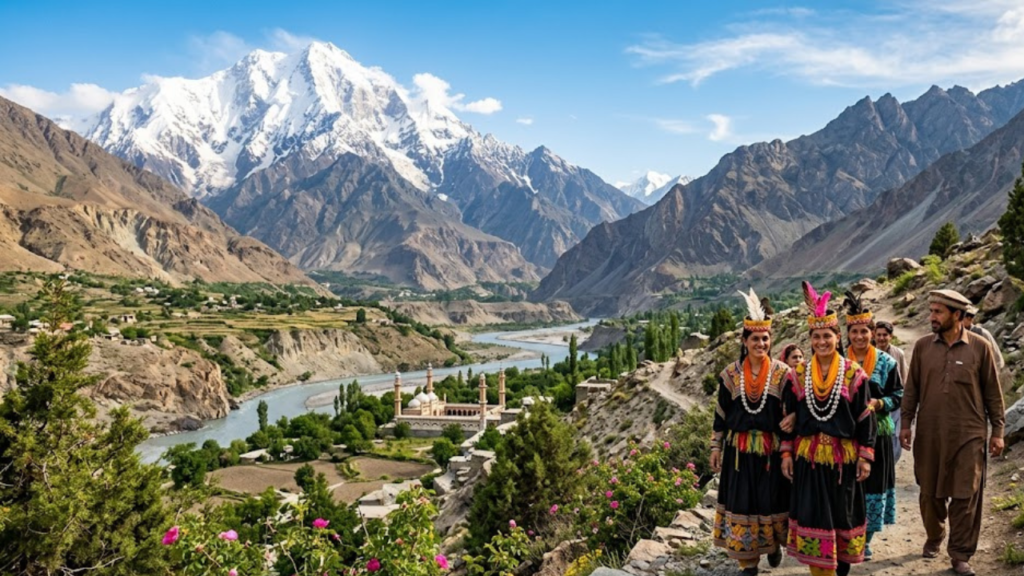

Chitral has a way of making you feel like you have arrived somewhere that the rest of the world has not quite found yet. Partly this is geography — the district sits in the northwestern corner of Khyber Pakhtunkhwa, hemmed in by the Hindu Kush on one side and the Afghan border on another, connected to the rest of Pakistan through the Lowari Tunnel that replaced what used to be a seasonal mountain pass only open for a few months a year. Partly it is the culture — a place where three distinct ethnic groups, the Kho, the Kalash, and Chitrali Nuristani communities, have lived in the same valley system for centuries with traditions that have no equivalent anywhere else in South Asia.
Most first-time visitors come for the Kalash Valley. They leave with a much longer list of things they wish they had spent more time on.
This guide covers the full range of things to do in Chitral, with honest information about what each activity actually involves, what time of year works best, and where most travel guides get the experience wrong. Chitral rewards travelers who do their homework. It punishes those who show up without a plan and expect to improvise in a district the size of a small country.
Getting There First: The Context That Shapes Everything
Before the activities, a word on access — because how you get to Chitral directly affects what you can do there.
The Lowari Tunnel, completed in 2017 at 8.5 kilometres, connects Dir to Chitral and has transformed the district from a seasonally isolated valley into a year-round destination. Before the tunnel, the Lowari Pass was blocked by snow for six to seven months a year, cutting Chitral off from the rest of Pakistan by road. The tunnel changed everything: hotels, tourism infrastructure, and visitor numbers all grew substantially after 2017.
PIA also operates flights between Islamabad and Chitral, but as with all mountain airport routes in Pakistan, weather-dependent cancellations are frequent. Flying in is faster, flying out is less predictable. Most experienced Chitral travelers recommend driving in via the Lowari Tunnel for the road experience and booking a return flight as a backup plan rather than a certainty.
The drive from Islamabad to Chitral via Dir takes approximately 8 to 10 hours on a good day. The last section after the tunnel, through the Chitral Valley itself alongside the Kunar River, is one of the most scenic approaches to any district capital in Pakistan.
The Kalash Valleys: The One Experience You Cannot Replace Anywhere Else
Of all the things to do in Chitral, the Kalash Valley experience is the one that stops people in their tracks — not because of scenery, though the scenery is extraordinary, but because of the civilization.
The Kalash people number approximately 3,000 to 4,000 individuals living across three valleys south of Chitral town: Bumburet, Rumbur, and Birir. They practice a pre-Abrahamic polytheistic religion with rituals centered on nature, seasonal cycles, and ancestor veneration. Their language, Kalasha-mun, is unrelated to any neighboring language. Their traditional dress — black woolen robes for women, decorated with elaborate headdresses of cowrie shells, colored beads, and large feathers — has been maintained with a fidelity that is remarkable given the surrounding cultural pressures. Some researchers have proposed connections to Alexander the Great’s army, which passed through this region around 327 BCE, though most modern linguists and anthropologists consider this origin story more legend than documented history.
What this means practically for visitors: the Kalash Valleys are not a cultural performance arranged for tourists. They are living communities with their own religious calendar, their own governance, and their own very clear ideas about how they want to interact with outside visitors. Understanding this before you arrive changes the quality of the experience entirely.
The three valleys are distinct and not interchangeable.
Bumburet is the largest and most accessible, 36 kilometres from Chitral town on a road that a regular car can navigate in most seasons. It has the most guesthouses, the most shops, and the most organized tourism infrastructure. The majority of visitors who “do the Kalash Valley” do Bumburet and nothing else. This is understandable but limiting. Bumburet is genuinely beautiful and culturally fascinating, but it also has the most commercialized relationship with tourism of the three valleys. The interaction feels slightly more curated than it does in the other two.
Rumbur is 32 kilometres from Chitral and significantly quieter than Bumburet. Travelers who have visited all three consistently describe Rumbur as their favorite. The hospitality from Kalash families here is more spontaneous and less touristically managed. There is a well-known disabled sculptor in Rumbur who has become something of a local legend — he does not speak English but welcomes visitors, and the Kalash residents who do speak English are happy to translate. The accommodation options are more basic than Bumburet but are mostly Kalash family guesthouses, which gives you a more direct experience of how people actually live.
Birir is the most remote of the three, 34 kilometres from Chitral on a rougher road. It sees a fraction of the visitors that Bumburet receives, and the Kalash community here maintains the most traditional relationship to its culture. Accommodation in Birir is limited — the government guesthouse is the most reliable option — and the experience requires more flexibility and less expectation of comfort. For travelers willing to accept those terms, Birir offers the most authentic encounter with Kalash life of the three valleys.
The festival timing matters enormously. The Kalash calendar has three major festivals: Chilam Joshi in May (spring festival celebrating the return of flocks from winter pastures), Uchaal in September (harvest festival), and Chowmos in December (winter solstice festival). Visiting during a festival changes the Kalash Valley from an interesting cultural site into something that visitors struggle to describe in ordinary travel language. The dancing, the music, the communal rituals — these are the real Kalash culture, not the daily interaction with guesthouse owners. If you can align your visit with Chilam Joshi in mid-May or Chowmos in late December, do it. It requires planning well in advance, particularly for May when the combination of spring weather and the festival draws visitors from across Pakistan and beyond.
How to behave as a visitor. The Kalash people have experienced decades of tourism and have formed very specific views about what they appreciate and what they find intrusive. Photography is a subject with nuance: asking before photographing individuals is not just polite, it is necessary. Some community members actively welcome photography, others do not. Entering private homes or religious spaces without explicit invitation is not acceptable. Dress conservatively, particularly in Birir where the community is more traditional. Buying directly from Kalash artisans rather than from shops in Chitral town that sell Kalash crafts benefits the community more directly.
Shandur Pass and the Polo Festival: The Highest Polo Ground in the World
At 3,700 metres above sea level, the Shandur Pass sits on the boundary between Chitral and Gilgit-Baltistan. The plateau at the top is broad, flat, and windswept, with a lake on one side and views that extend to peaks you cannot name because there are too many of them.
The Shandur Polo Festival is held annually in late June or early July, organized jointly by the governments of Gilgit-Baltistan and Khyber Pakhtunkhwa. In 2025, the festival ran from June 20 to 23 and drew thousands of local and international spectators. The format is freestyle polo — no umpires, no written rulebook, just riders and horses and the particular chaos that produces some of the most exciting polo anywhere in the world. Chitral has maintained a winning streak against Gilgit since 2011. The 2025 final went to extra time at 7-7 before Chitral’s Izhar Ali Khan scored twice to win 9-8, with both teams reduced to three players due to horse injuries. That is the kind of ending that makes the Shandur Polo Festival what it is.
The festival program extends beyond polo. The 2025 opening ceremony featured paragliding displays, military marching bands, and folk music. A camping village is set up around the polo ground for the duration of the festival. Angling competitions are held at Shandur Lake. The combination of sport, music, altitude, and scenery produces an event that travelers who have attended describe as unlike anything else in Pakistan.
Visiting Shandur outside festival season is a different but equally valid experience. The pass is accessible from April to November. On a quiet weekday in August, the plateau is largely empty, the lake is clear, and the views of the surrounding Hindu Kush are undisturbed by any crowds. The drive up from Chitral town through Mastuj is spectacular — a mountain road running alongside the Yarkhun River with the Hindu Kush gradually closing in on both sides.
Practical note: Shandur Pass sits at the Chitral-Gilgit Baltistan boundary. Entering GB from this point adds a checkpoint and some administrative requirements. Carry your CNIC or passport. The road condition requires a 4×4 vehicle from Mastuj onward, and the pass itself is not recommended for sedan cars even in summer.
Tirich Mir: Living With the Highest Peak of the Hindu Kush
Tirich Mir stands at 7,708 metres — the highest mountain in the Hindu Kush range and the 33rd highest peak in the world. It is visible from Chitral town on clear days, a massive white presence to the northwest that dominates the skyline the way few mountains dominate any skyline.
The name comes from Wakhi — “Trich” meaning darkness and “Mir” meaning king, giving it the translation “King of Darkness,” a reference to the shadows it casts over the Wakhan Corridor to the north.
The viewpoint experience. You do not need to trek to appreciate Tirich Mir. From the Governor’s Cottage area near Chitral Fort, the view on a clear morning is extraordinary. The mountain is far enough away that you can see its full profile — the summit, the glaciers, the ridgelines — in a way that you cannot when you are standing close to a peak. Early morning before 9am produces the best visibility before heat haze develops.
The base camp trek. For serious trekkers, the Tirich Mir base camp trek is one of the most demanding and rewarding routes in Pakistan’s northwest. The standard approach is via Zani Pass. The trek takes approximately seven days and passes through Tirich Mir Valley, with guides providing context on the landscape and the communities along the route. This is not a trek for beginners — the altitude, terrain, and remoteness require proper fitness, experience, and a local guide who knows the route. The rewards are proportional.
Chitral Gol National Park: Where Pakistan’s National Animal Lives Freely
Most people who come to Chitral do not put Chitral Gol National Park on their list of things to do in Chitral, and this is a mistake that regular visitors to the district find slightly baffling.
Chitral Gol is a protected area of 7,750 hectares established specifically to protect the Markhor — the spiral-horned wild goat that is Pakistan’s national animal. The park sits just outside Chitral town, approximately a 30-minute drive, and is one of the most reliable places in Pakistan to see Markhor in their natural habitat. The animals are accustomed enough to visitors that sightings are relatively frequent, particularly in the early morning when they move to lower elevations.
The park also has recorded sightings of snow leopards, though these are rare and require considerable patience and luck. The landscape is dramatic — steep valley walls covered in pine and oak forest dropping into a river gorge, with the upper elevations transitioning to alpine meadows and rocky terrain.
Wildlife photographers who have visited Chitral Gol describe it as one of the better wildlife photography destinations in northern Pakistan, specifically because the Markhor population is large enough and habituated enough that getting close views does not require multi-day trekking into remote areas.
Entry to the park requires a permit, available from the KPK Wildlife Department office in Chitral town. A guide is strongly recommended both for wildlife tracking and for navigating the park’s trail system.
Garam Chashma Hot Springs: Two Hours from Town, Completely Different World
Garam Chashma — “hot springs” in Urdu — is a valley approximately 45 kilometres north of Chitral town, accessible in two to three hours by road. The hot springs themselves are the main attraction: thermal water at temperatures that vary by pool, emerging from the hillside and flowing through a landscape of snow-capped peaks, river gorge, and poplar groves.
The therapeutic reputation of Garam Chashma extends throughout the region. People come specifically to soak for days as a treatment for skin conditions, joint pain, and respiratory ailments. Whether the thermal water has genuine medicinal properties is a question for rheumatologists, but the experience of sitting in naturally heated mineral water with a mountain view is not one that requires medical validation to justify.
The drive to Garam Chashma is worth the trip independently of the hot springs. The road follows the Lotkoh River through increasingly remote terrain, with small Chitrali villages perched on hillsides and agricultural terraces that have been worked for centuries. The trout fishing in the Lotkoh River is excellent and permits are available locally.
The honest caveat: the actual hot spring facilities have attracted criticism from some visitors for encroachment and inadequate management. The natural source itself is beautiful, but the built infrastructure around it is basic and the organization of access can be chaotic on busy days. Arriving on a weekday morning avoids the worst of this.
Accommodation in Garam Chashma is limited but available. Hotel Injigaan is the most frequently mentioned option in traveler reviews, with bath facilities that are reportedly better than most alternatives in the area.
Chitral Fort and the Shahi Mosque: History in the Valley Floor
Chitral Fort dates to 1774, built during the reign of Mohtaram Shah Katur II. It was restored in 1911 by Sir Shuja ul-Mulk, who used it as the stronghold of the Mehtar — the traditional ruler of Chitral State. The fort is currently under the care of the ceremonial ruler Fateh-ul-Mulk Ali Nasir, and its Darbar Hall and state rooms have been preserved rather than converted.
The honest assessment: Chitral Fort is historically significant and architecturally interesting, but it lacks the presentation infrastructure of better-developed heritage sites. There are no extensive informational displays, the guided experience depends heavily on who is available to show you around, and some sections show the effects of time and limited restoration budget. A recent Tripadvisor reviewer noted that the fort looks somewhat deserted due to insufficient maintenance, and that with proper management it could be a much stronger heritage attraction than it currently is.
What Chitral Fort does well: the view. The position above the Chitral River gives panoramic sightlines over the valley floor and toward Tirich Mir to the northwest. The Governor’s Cottage nearby offers an even better elevated view. These vantage points are worth the visit independently of the fort’s interior condition.
The Shahi Mosque next to the fort is an active place of worship and one of the older mosques in the district. Visitors are welcome outside prayer times. The architecture incorporates traditional Chitrali woodcarving that is distinctive from the mosque styles of the plains.
The Chitral Museum, established in 2010 and located within the fort complex, is divided into an Ethnological Gallery and an Archaeological section. The ethnological collection covers Kalash artifacts, traditional Chitrali weapons, musical instruments, and textile work. It is modest by national museum standards but covers the specific cultural heritage of the district with more depth than any general Pakistan museum could.
Qaqlasht Plateau: The Viewpoint That Most Visitors Miss
Qaqlasht is a high-altitude meadow plateau above Chitral town, accessible by a mountain road that climbs steeply from the valley floor. At the plateau, the view back over Chitral town and the surrounding Hindu Kush range — with Tirich Mir dominating the northwest — is one of the best panoramic views in the entire district.
Most Chitral visitor itineraries do not include Qaqlasht simply because it does not appear prominently in standard travel guides. This is the kind of gap that benefits visitors who do more research than average. The plateau is accessible by vehicle with some road condition variation by season, and by foot on a half-day hike from town.
Local families use Qaqlasht as a summer picnic destination. The meadows are green in the warmer months, the wildflowers appear in June and July, and the air temperature at elevation is meaningfully cooler than the valley floor. A thermos of tea at Qaqlasht watching the light change on Tirich Mir is the kind of simple Chitral experience that stays with you longer than any organized activity.
Practical Information for 2026
Best time to visit Chitral: May to October covers most of the peak activities. May combines the Chilam Joshi festival with the beginning of proper mountain weather. June and July offer full access to Shandur Pass, Garam Chashma, and Chitral Gol. September is the quieter shoulder season with excellent weather. The Shandur Polo Festival in late June is worth building an entire trip around.
Getting to the Kalash Valleys: Bumburet is manageable in a standard car. Rumbur and Birir require a jeep or 4×4 particularly in wetter conditions. Local jeep rentals are available in Chitral town. Agree on the full day rate before departure — Rs. 4,000 to 8,000 per day is the current market range depending on destination and vehicle condition.
Accommodation in Chitral town: Hotel Fairland and Hotel Al Farooq are the most consistently mentioned mid-range options. The government-run PTDC Motel is a reliable choice for travelers who prioritize cleanliness and predictability over local character. Book ahead for May to August, particularly if your visit coincides with Kalash festival dates.
Mobile connectivity: Chitral town has reasonable mobile coverage from major Pakistani networks. The Kalash Valleys have limited to no connectivity, particularly Rumbur and Birir. Garam Chashma is similarly patchy. Download offline maps before leaving town.
Security and permits: Chitral is considered safe for tourists. Foreign visitors may need to register with the local police on arrival — the process is straightforward and the relevant offices in Chitral town will direct you. For the Kalash Valleys, no special permit is required for Pakistani citizens. Foreign visitors should carry their passport.
How Chitral Connects to the Broader Northern Pakistan Circuit
Things to do in Chitral make most sense in the context of a longer northern Pakistan journey. Most travelers reach Chitral after coming through Dir, either from Peshawar or from the Swat Valley circuit. The road connection through the Lowari Tunnel has made it possible to include Chitral as part of a northern loop rather than a separate out-and-back trip.
The natural onward route from Chitral is via Shandur Pass into Gilgit-Baltistan — connecting to the Gilgit, Hunza, and Skardu circuit. This route requires planning around season and road conditions, but it creates one of the great overland journeys in Pakistan: starting in the Hindu Kush at Chitral and arriving in the Karakoram at Skardu, with the Shandur plateau as the literal and figurative high point of the crossing.
Our detailed comparison of winter travel in northern Pakistan covers the full arc of this northern circuit, including how the food, accommodation, and travel experience changes as you move from KPK into GB.
If Skardu is part of your itinerary after Chitral, our Skardu summer vs winter comparison is worth reading before you commit to a season. The onward decision from Chitral often hinges on what you want from the Skardu portion of the trip.
Most northern Pakistan journeys start in Islamabad. Our guide to things to do in Islamabad covers the capital as a destination worth spending real time in rather than simply a departure point for the north.
For travelers building a longer Pakistan itinerary that combines the mountains with the cultural heartland of Punjab, our Multan guide covers the southern Punjab end of the spectrum — as different from Chitral as any two places within a single country can be.
The best dhabas on the Lahore-Islamabad motorway are the practical food connection on the journey north — our M2 motorway food guide covers exactly what to eat at each service area on the drive that most northern Pakistan trips begin with.
For anyone interested in the broader context of how Pakistani mountain culture compares to what exists in neighboring countries, our piece on covers some of the lesser-documented regions that fill the gaps between the famous northern circuit stops.
One external resource worth bookmarking: the KPK Tourism Department official site maintains updated information on permit requirements, festival dates, and road conditions for Chitral and the broader Khyber Pakhtunkhwa region. Festival dates in particular shift annually based on provincial government decisions, and the official source is more reliable than any travel blog for confirming current-year timing.
Frequently Asked Questions
The Kalash Valleys — specifically Bumburet with a day trip to Rumbur — are the non-negotiable first-time experience. Pair this with Chitral Gol National Park for Markhor sightings and the Tirich Mir viewpoint from near Chitral Fort. If your timing allows, add Shandur Pass for the drive and the view.
Bumburet for accessibility and a complete introduction. Rumbur for the best authentic cultural interaction. Birir for the most remote and traditional experience. If time allows even two days, split it between Bumburet and Rumbur. Most visitors who have done all three say Rumbur was their favorite.
Yes. Chitral has an excellent safety record for tourists. The local Chitrali and Kalash communities are known for their hospitality and the district has had no major security incidents affecting tourists in recent years. Standard mountain travel precautions apply — inform someone of your plans, carry cash, and check road conditions before departing for remote areas.
A minimum of four days to cover the main things to do in Chitral without rushing: one day in town and Chitral Gol, one and a half days in the Kalash Valleys, half a day at Garam Chashma, and one day for Shandur Pass or Qaqlasht. Seven to ten days allows a more complete experience including slower travel and the Shandur route into Gilgit-Baltistan.
The Lowari Tunnel is an 8.5-kilometre road tunnel completed in 2017 that connects Dir to Chitral through the Lowari Pass mountain. Before the tunnel, the pass was closed by snow for six to seven months annually, making Chitral a seasonal destination. The tunnel is open year-round and has transformed Chitral from a summer-only destination to a district accessible in all seasons.
Chitral rewards travelers who approach it with curiosity rather than a checklist. The things to do in Chitral that stay with you longest are rarely the ones in the standard itinerary — they are the conversation with a Kalash elder in Rumbur, the view from Qaqlasht when no one else is there, the Shandur polo final going into extra time. If you have been to Chitral and found a spot or an experience that is not on this list, the comments section is the right place for it. The best travel information always comes from people who were just there.

Pingback: Hunza Apricot Season: When to Go and What to Expect